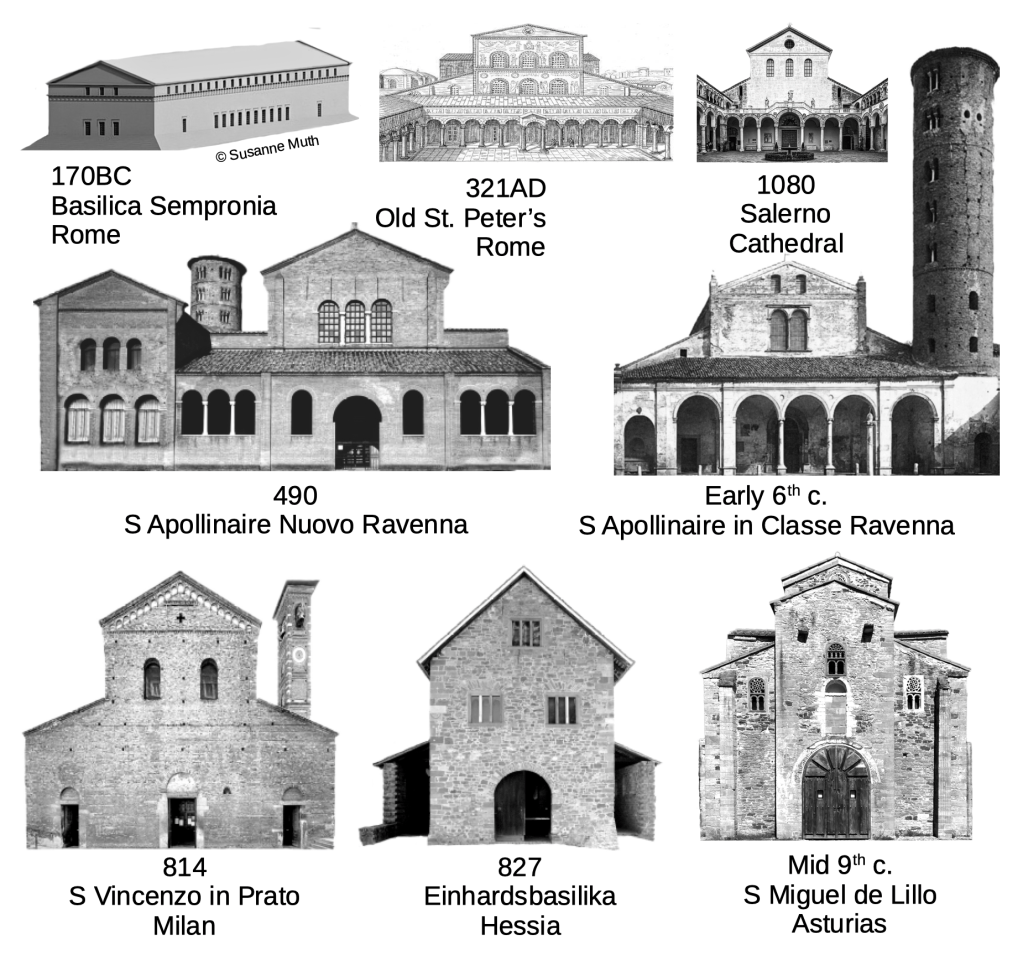
Early Christian churches featured relatively plain exteriors, contrasting with their richly adorned interiors. These structures adapted the Roman basilica—a large, rectangular hall exemplified by the Basilica Sempronia. Christians reoriented the basilica’s layout from east to west. They established a central pathway, or nave, that extended through the basilica, leading to an altar located at the eastern end. The nave, two stories tall, was flanked by single-story side aisles. This configuration gave the western facade a distinctive silhouette: a prominent, two-story central gable bordered by sloping, single-story rooflines.
Old St. Peter’s Basilica in Rome, founded in 321 AD, exemplified this archetypal design with its high central gable flanked by lower sloping roofs. A loggia and atrium were added around 390 AD. (Atriums were regular features of early Christian basilicas and one of the few to survive is the 1080 Salerno Cathedral, shown above.) The original St. Peter’s Basilica was demolished in 1505 to make way for Michelangelo’s mammoth Baroque basilica. Among the oldest surviving basilicas that retain their original facades are S. Apollinare Nuovo (built in 490 AD) and S. Apollinare in Classe (early 6th century), both located in Ravenna. Cylindrical towers, added in the 9th century, became a notable feature, though bell towers had been attached to churches as early as the 5th century.
Few churches from the “Dark Ages” (approximately 500–1000 AD) have survived. The remaining examples, such as the three churches in the lower part of the figure 1, exhibit simple facades with the classic high central gable flanked by lower roofs. S. Vincenzo in Prato illustrates the evolution of tower design, featuring a square tower that gradually replaced the older cylindrical style in Italian church architecture. However, rounded towers and turrets remained prominent in German-speaking regions, where they enjoyed a long-lasting architectural legacy.
Early German Westworks
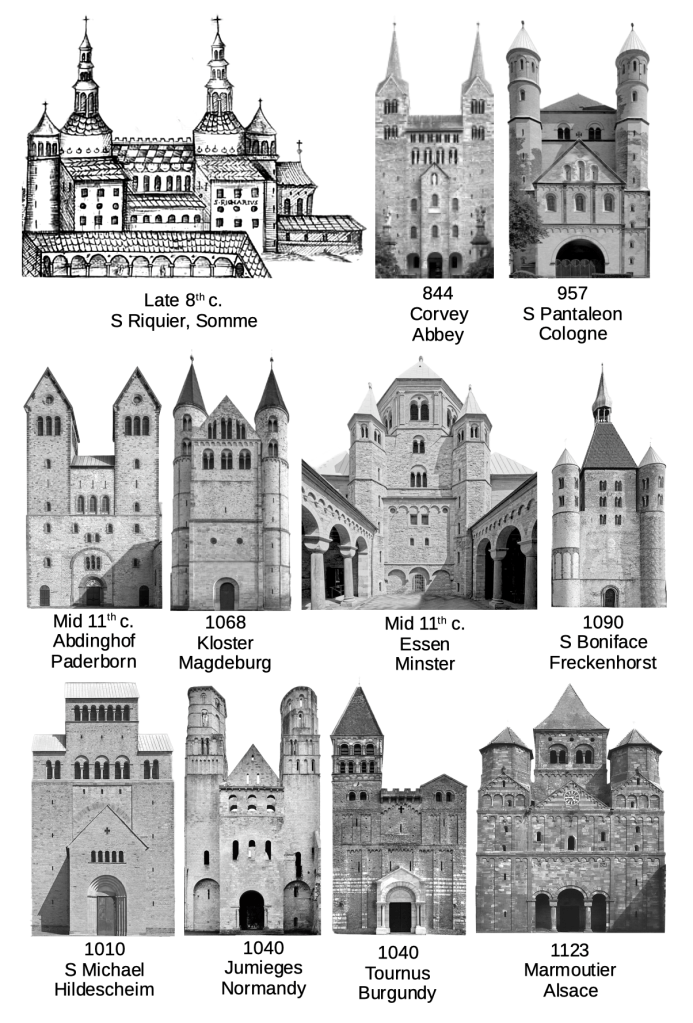
Church facades underwent a dramatic transformation during the reign of Charlemagne, crowned emperor of the new Holy Roman Empire in 800 AD. Under his influence, many significant churches were equipped with “westworks”—elaborate, multi-story structures featuring towers, chapels, a throne, and spaces for both ecclesiastical and judicial functions. These imposing westworks projected the church’s elevated authority within the Holy Roman Empire and symbolized the emperor’s role as both ruler and protector of the church.
The earliest surviving westwork is found at Corvey Abbey, built in 844 AD. However, a medieval illustration of the now-lost S. Riquier Abbey, constructed in the 790s, provides a glimpse into earlier designs. The westwork of S. Riquier (located on the left end of the illustration above) included a central tower and, later, an attached towered choir. Like S. Riquier, Corvey Abbey’s westwork originally featured a central tower. With this central tower, flanked by the extant side towers, Corvey probably resembled surviving westworks at Essen Minster and S. Boniface in Freckenhorst (fig. 2).
Over time, architects began integrating these spaces into a single, open area that often connected directly to the church’s nave, as seen at S. Pantaleon. However, the westwork at Tournus, built around 1040, retained separate chapels similar to those at Corvey. This tradition of compartmentalized chapels persisted for centuries, with many of the chapels dedicated to the militant St. Michael, reflecting the martial character associated with westworks.
One of the final true westworks constructed was at Marmoutier Abbey in Alsace, completed in 1123. (Note: The dates referenced in illustrations generally indicate the construction of the facades rather than the entire church structure.)
West End Choirs and Towers
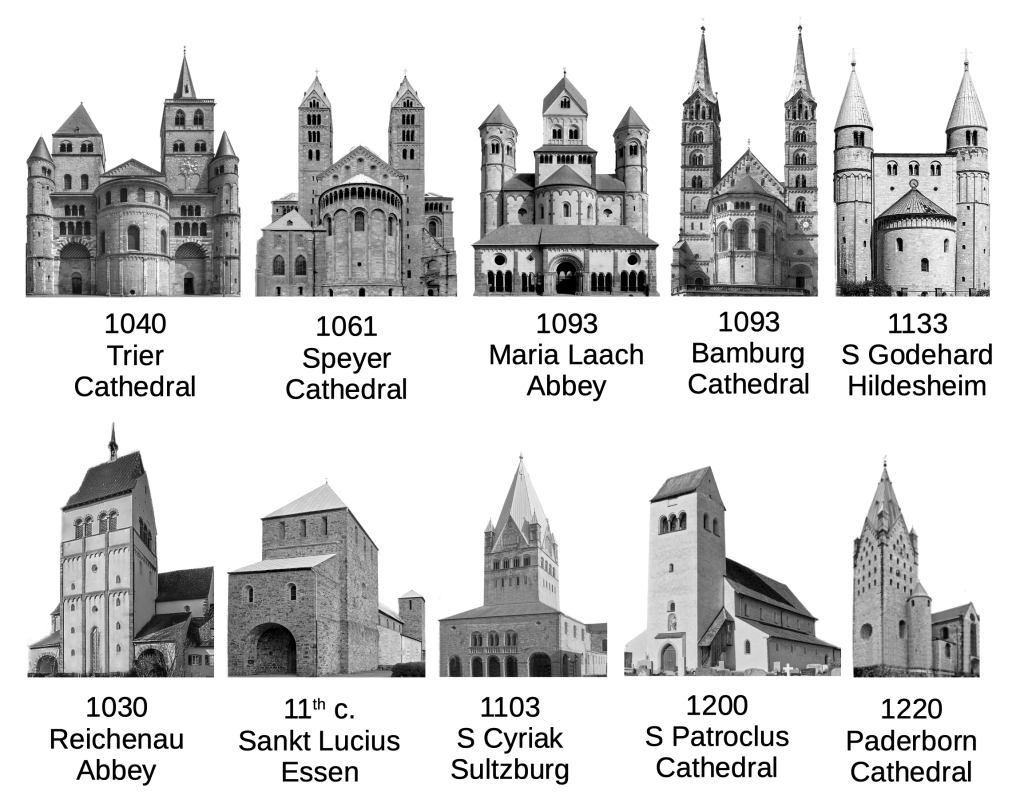
Traditionally, church facades feature grand west entrances, while the east ends were reserved for rounded apses housing choirs. However, during the 11th century, it became common to add choirs at both ends of churches—a practice already evident in the design of St. Riquier (fig. 2). The churches depicted in the top row of figure 3 appear to be east ends, but are actually west ends (with the exception of the illustration of Speyer Cathedral). This shift reflected the increasingly elaborate liturgical practices of the time. (Speyer’s west end closely resembles its east end. However, it was not included in the illustration because it is not photographable due to surrounding buildings.)
These churches also exhibit architectural features influenced by Italian styles, which began to spread into German-speaking regions during the 11th century. Italian influence can be seen in the dwarf galleries encircling the top of the apse at Speyer and Bamberg Cathedrals, as well as the arcaded Lombard bands decorating the rooflines of Maria Laach Abbey.
In the 11th and 12th centuries, grand rectangular towers were often added to the facades of smaller, pre-existing basilicas. (The dates provided in the illustration correspond to the construction of these towers rather than the entire church.)
Early French and Burgundian Facades
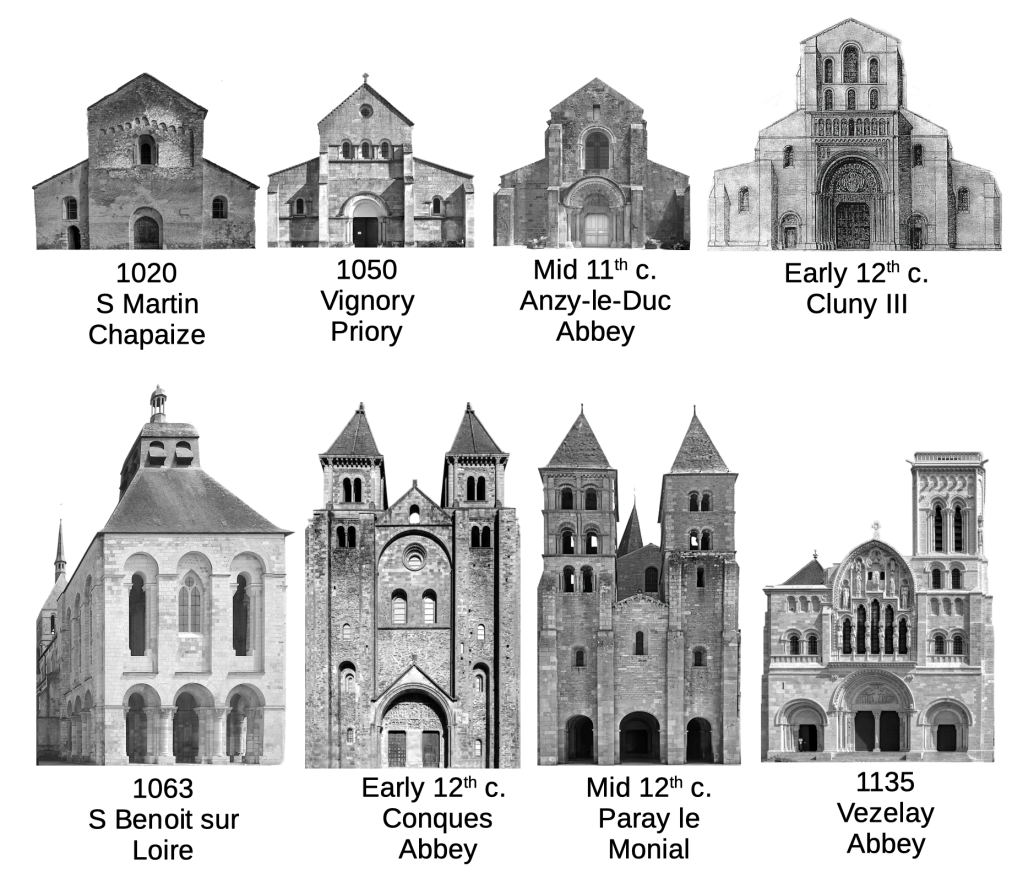
France suffered significant setbacks during the 10th century due to devastating Viking raids. As a result, little survives from the 10th and 11th centuries. The notable exception was Burgundy, which, under the protection of the powerful warlord Richard the Justiciar, remained safe from Viking incursions. This stability allowed Burgundy to become a refuge for monastic communities, which grew in wealth and influence, eventually rivaling the power of the Church in Rome. Burgundian monastic power culminated in the construction of Cluny III in the early 12th century, a monumental double-aisled basilica featuring a triple-gabled roofline and an elaborately decorated facade.
One of the earliest surviving Burgundian abbeys from this period is St. Martin Chapaize (1020), which is adorned with a simple course of roughly hewn Lombard bands. At Anzy-le-Duc and Vignory Abbey, built just a few decades later, the construction had evolved considerably, with facades articulated by sturdy buttresses. They feature recessed windows and elaborate columned doorways with sculpted tympanums set within an arc of multiple archivolts. These layered archivolts were to become part of the standard Romanesque vocabulary.
The 12th century saw the increased use of towered facades in France, heavily influenced by Norman architecture (discussed in the next section). Unlike the flat, shallowly decorated westworks of German churches, Norman-inspired French facades were characterized by massive buttresses, lending them a dynamic, three-dimensional appearance. S. Benoit-sur-Loir (1063) was the first building to incorporate engaged shafts (columns attached directly to piers or walls), a feature that would become a defining element of later Romanesque and Gothic styles.
Vézelay Abbey boasts Burgundy’s finest church facade and narthex, featuring an acclaimed set of sculptures depicting the Last Judgement. These sculptures provide a glimpse of the exceptional craftsmanship that must have adorned Cluny III before its destruction during the French Revolution.
Norman Facades
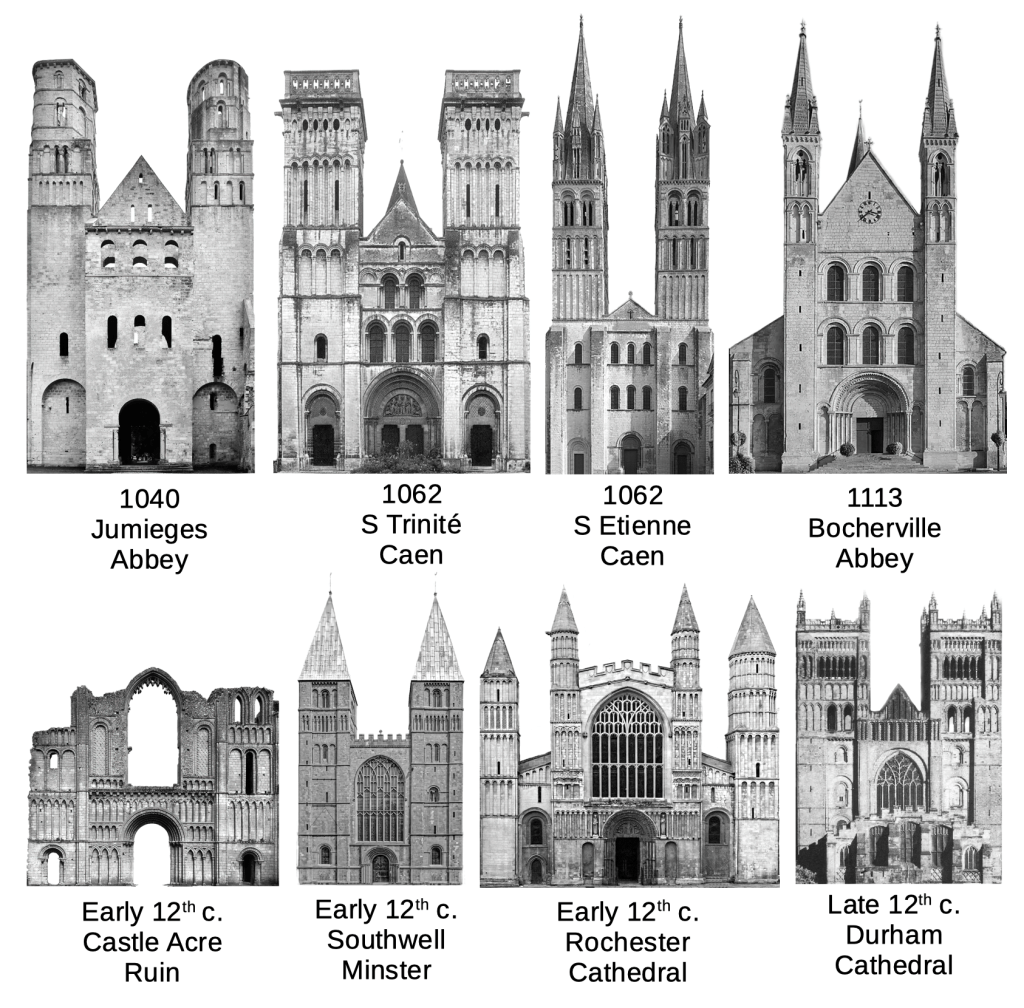
Normandy embraced the two-towered church facade a century earlier than the rest of France. Following their subjugation by Richard the Justiciar, the 10th-century Viking raiders were granted lands in Normandy on the condition that they abandon their life of plunder. The Normans adopted the French language and became fervent proponents of a militant Christianity, reflected in the bold and imposing character of their church facades.
In 1066, the Normans conquered England, where they developed a distinctive architectural style characterized by robust, castellated structures with vigorously articulated facades. They also established several Cluniac monasteries, bringing architectural innovations from Cluny III to England. A prime example is Castle Acre, which features an elaborate facade encrusted with bands of blind arcades. Similar decorative arcades can be observed at Rochester Cathedral and in the towers at Southwell and Rochester. (Note: the large windows in these English churches are later Gothic additions.)
Italian Romanesque
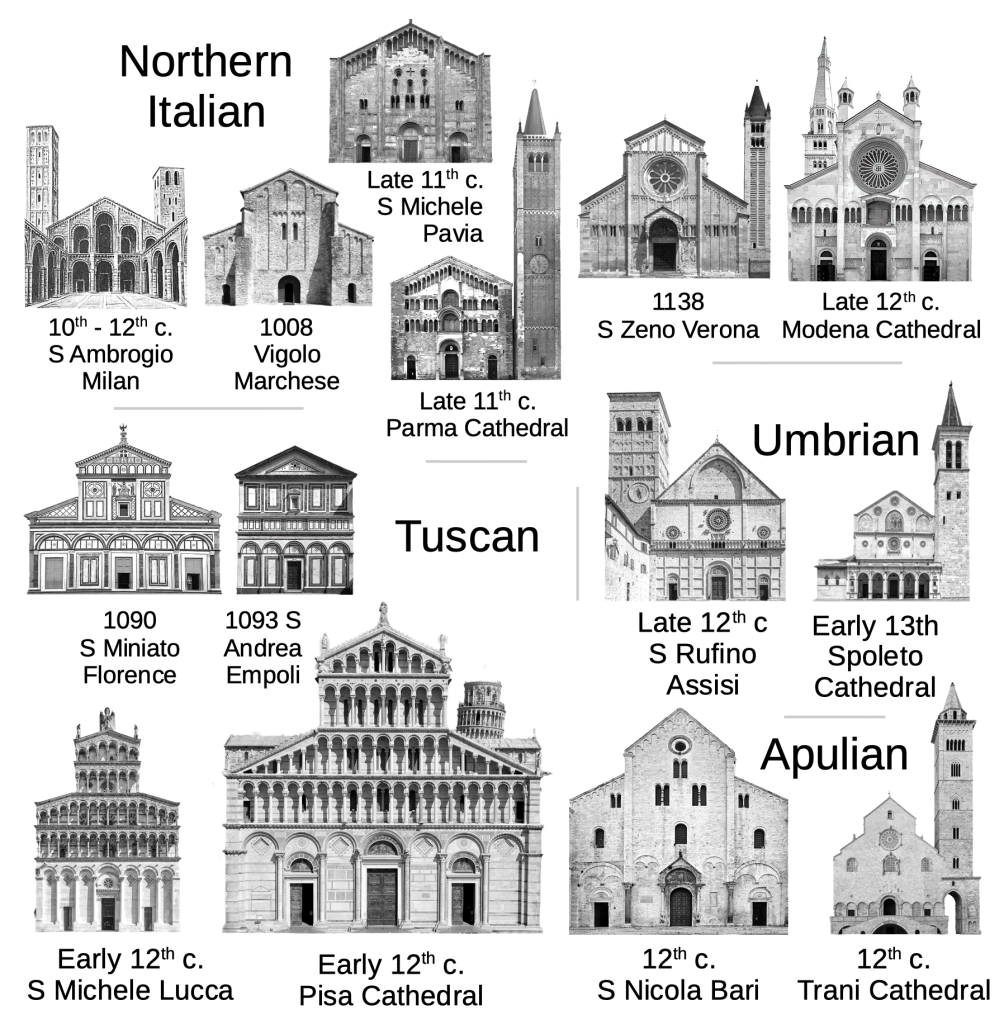
In the 7th and 8th centuries, the Lombard kings of Northern Italy embarked on an extensive building program, most of which has been lost to history. However masons from the Lombard architectural tradition became prized throughout Europe, spreading the Lombard style with them.
S. Ambrogio in Milan represents a significant fusion of the roman basilica form with Lombard construction techniques. The current facade, rebuilt in the 12th century, reflects the design of an earlier 9th-century structure. The lower bell tower dates from the 9th century, while the taller one was added between 1128 and 1144. S. Abrogio and Salerno Cathedral (fig. 1) are the oldest churches to retain their original atriums.
The facade of Vigolo Marchese (1008) showcases Lombard-style banded arcades, which were later adopted across Europe (for example Maria Laach Abbey in fig. 3). The dwarf galleries beneath the gables at S. Michele in Pavia and Parma became popular in 11th-century German cathedrals (fig. 3). The western choirs at Speyer and Bamberg Cathedrals bear remarkable similarities to the eastern choir at Modena, highlighting the architectural connections between the Italians and the Germans.
The facades at S. Zeno and Modena showcase a new and more sophisticated approach to design. S. Zeno’s large central window and wide portico are balanced within a grid of subtle vertical pilasters and a horizontal colonnade, creating a harmonious hierarchy of forms. Modena, on the other hand, features groups of three smaller arcades within larger arched groupings, drawing on the symbolism of the Trinity.
Architecture in Tuscany took a completely different turn. S. Miniato and S. Andrea have polychromatic geometrical facades that would inspire Florentine Renaissance architects centuries later. The greatest achievements of Italian Romanesque are Pisa Cathedral and Lucca’s S. Michele. These magnificent facades not only reflect the wealth and cultural sophistication of the Tuscan church, but also the unique qualities of the region’s soft Carrara marble, which allowed for delicate carving. This enabled Tuscan architects to elevate the arcaded galleries introduced at Parma to a new level of virtuosity.
The figure above includes regional variations from Umbria and Apulia. In the two Umbrian examples, motifs found at S. Zeno are reinterpreted with smaller, more numerous circular elements set within a grid of horizontal and vertical lines. Apulian facades, like those at S. Nicola in Bari, feature bands of blind arcades. However, in Bari, the arcades are spaced more widely apart, creating a melodious effect with a less pronounced rhythm than in other Northern Italian facades.
Regional Romanesque Variations
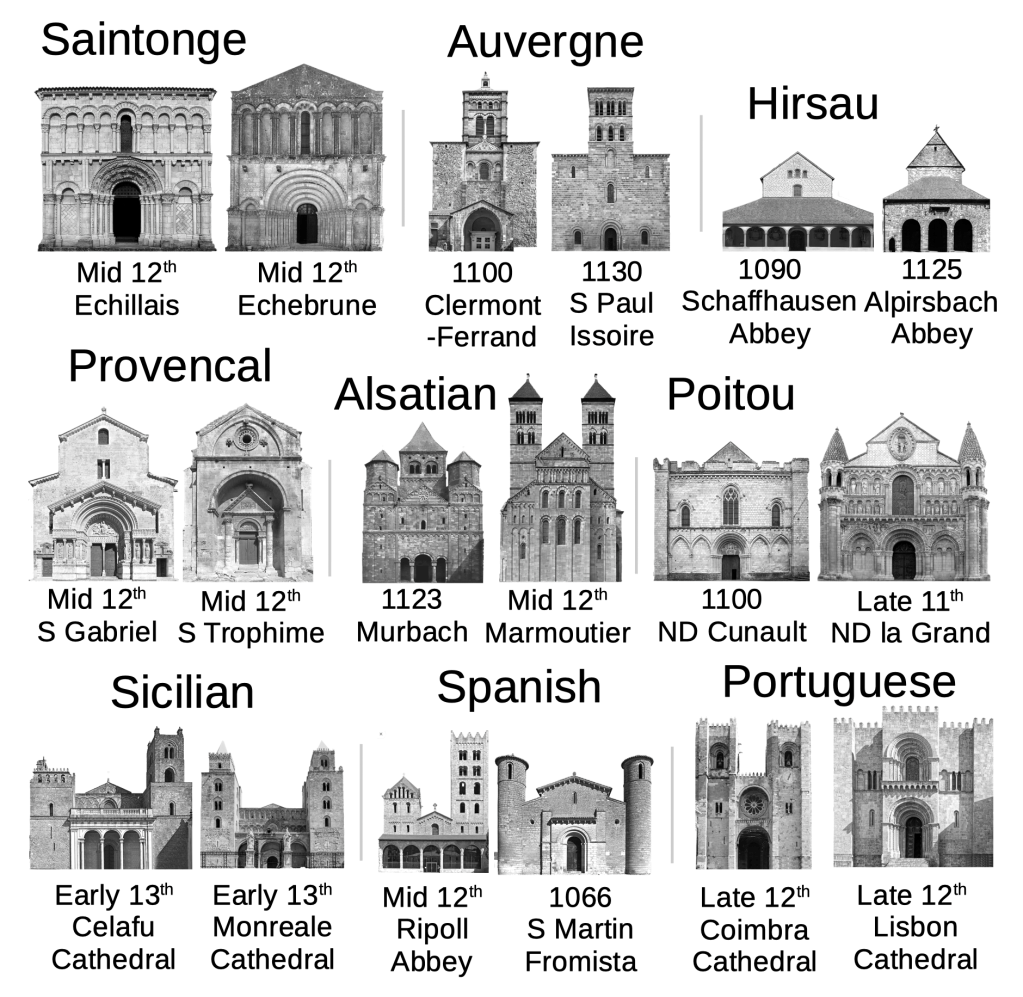
Norman and Burgundian Romanesque were perhaps the most influential regional styles in the 11th and 12th centuries. However, the Romanesque period saw a remarkable diversity of architectural expressions across Europe. The illustration above showcases nine distinct regional variations, each with its unique characteristics.
In Saintonge, churches feature intricately carved white limestone facades. Provençal Romanesque draws heavily on classical motifs, inspired by the numerous Roman ruins scattered throughout the region. Alsatian Romanesque is distinguished by its massive yet elegant westworks, while Hirsau Romanesque retains the straightforward and unadorned character of early Christian basilicas.
In Poitou, churches adopted the “hall type” design, characterized by high, two-story aisles that nearly matched the height of the nave. This design resulted in distinctive, squarish facades. In Sicily, Spain, and Portugal, Romanesque architecture displayed a strong preference for castellated, two-tower designs, emphasizing strength and fortification in their aesthetic.
Early French Gothic
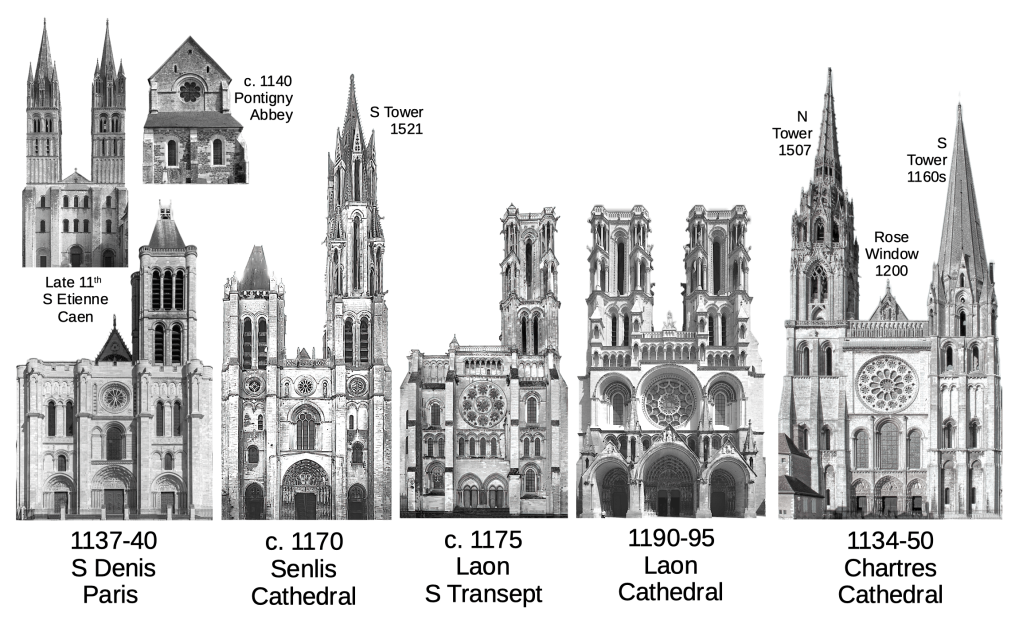
The 1137 facade of S. Denis in Paris marks the beginning of the Gothic period. Built in the westwork tradition, it features upper chapels and incorporates prototypical Norman buttresses similar to those at S. Étienne in Caen. However, the buttressing at S. Denis is more elaborate, with additional castellated elements. S. Denis is the first facade to incorporate a central rose window—an evolution of the cusped oculi seen in Cistercian monastic architecture, such as the transept window at Pontigny Abbey. Although the original stone tracery of the rose window at S. Denis has not survived, it may also have been cusped. Another groundbreaking feature is the use of full-sized statues in the door jambs, which became a hallmark of Gothic facades.
The surviving tower at S. Denis is misaligned with the lower facade, a result of the original proportions of the attached nave. This issue was corrected in the 1170 facade of Senlis Cathedral, which closely follows the S. Denis model while achieving a better alignment between the facade and the towers. However, Senlis reduced the prominence of the rose window, replacing it with a smaller version flanked by two additional oculi. Laon Cathedral’s south transept (1175) took a significant step forward by introducing a full-sized rose window—a beautiful arrangement of nine cusped oculi. While the transept retained the buttressed frame seen at Senlis, the larger rose window marked a new development in Gothic design.
The west facade of Laon Cathedral (1190) introduced even more remarkable innovations. The previously pronounced vertical buttresses were de-emphasized by deeply recessed windows and three projecting gabled porticos. These porticos feature additional pinnacles at their sides, a motif repeated at the base of each of the towers. The towers themselves incorporate angled aedicules, creating an octagonal effect—a design element possibly inspired by the lower level of the south tower of Chartres Cathedral (1160s), which also features angled aedicules at its base.
Some of the innovations at Laon arose from the need to address discrepancies between the facade and the nave aisles. Adding pronounced vertical buttresses would have highlighted the misalignment, so architects instead disguised the buttresses with portico projections and window recesses. Ironically, these solutions became standard features in the Gothic architectural vocabulary.
Chartres Cathedral’s facade presents a different approach to early Gothic design. Unlike the evolving pattern seen at S. Denis, Senlis, and Laon, Chartres adapts elements of a pre-existing 11th-century facade. Apart from the magnificent rose window added in 1200, the central portion of the facade reflects its earlier Romanesque origins. Chartres’ massive nave necessitated equally large side towers with their own sets of tripartite buttresses, ensuring the facade could span the cathedral’s full width.
French High Gothic to Rayonnant
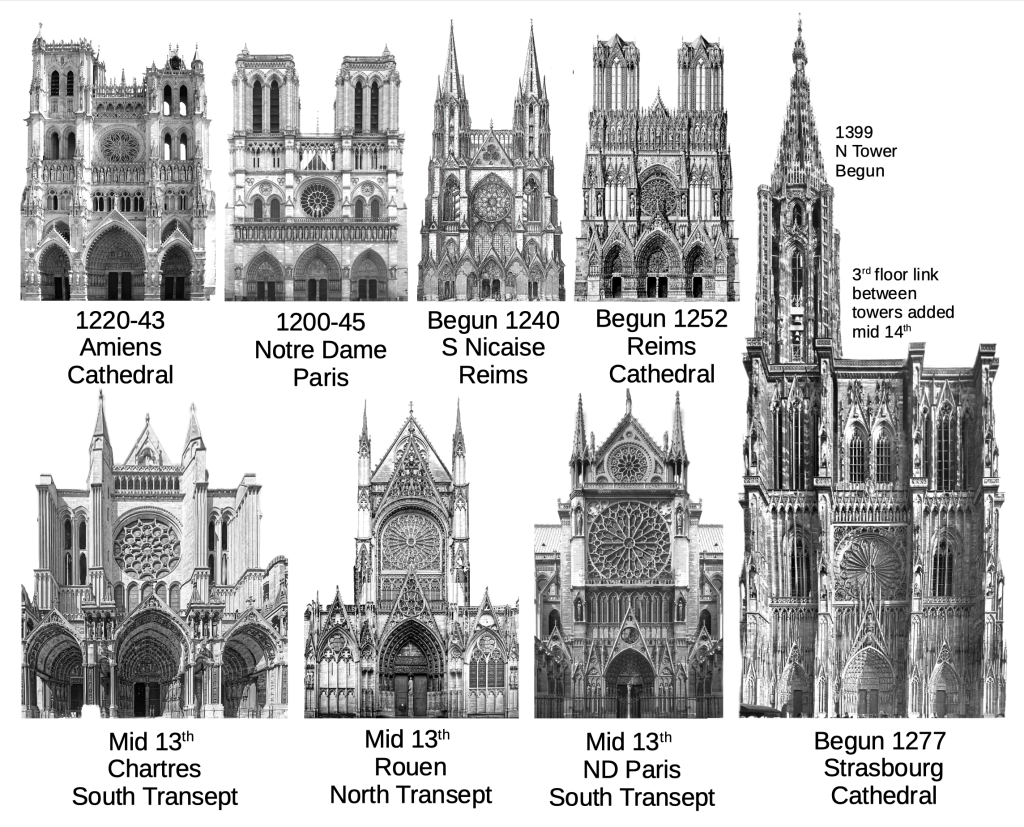
Gothic architecture reached new heights through innovations such as the pointed arch and flying buttresses, which required significant adaptations to facade design. Amiens Cathedral, the tallest Gothic structure yet built, illustrates these challenges. Its immense height necessitated raising the rose window, disrupting the harmonious proportions seen in the facades of Laon and Chartres. Two layers of arcades separate the rose window from the gabled porticos below, resulting in an awkward overall composition. Despite this, Amiens pioneered the extensive use of sculptural ornamentation and encrustation, which covers nearly the entire surface of its facade.
Notre Dame Paris was designed with more manageable proportions, resulting in a facade of pleasing rectilinearity. It also abandons the protruding gables and attached pinnacles of Laon, making it more classically self-contained.
Chartres Cathedral on the other hand, enthusiastically adopted the Laon-style telescoped porticos for its north and south transepts. These contain some of the most richly sculpted compositions in High Gothic architecture.
During this period, the Gothic style evolved further in Riems, where two 13th-century churches became prototypes of the “Rayonnant” phase of gothic architecture, a style characterized by delicate window tracery. Reims Cathedral combined Amiens’ ornate approach with better proportions, achieving a more harmonious facade. S. Nicaise (destroyed during the French Revolution), favored elegant arrangements of blind tracery over Amiens’ heavily encrusted ornamentation. It also contained tall, symmetrical spires on both towers, giving us a taste of what all the 13th century gothic cathedrals might have looked like if they had been built according to their original plans.
Rayonnant innovations reached new heights in structures such as the Rouen Cathedral north transept and the south transept of Notre Dame in Paris, both celebrated for their stunning tracery designs. Strasbourg Cathedral’s facade (1277-) represents the pinnacle of the Rayonnant style, adding “harp tracery,” a delicate arcade of shafts overlaying the facade.
Northern European Gothic

During the Hundred Years’ War (1337–1453), much of France’s power and wealth flowed to England and the Burgundian Empire, which encompassed the prosperous city-states of Belgium and the Netherlands. As a result, many architectural innovations of the 14th and 15th centuries emerged not in France, but in England and the Low Countries. Germany was also experiencing rapid urban growth as cities like Cologne became important cultural hubs. Innovations from these countries were adopted back in France during the late medieval period. This survey will take a brief look at developments in these other countries before returning to France to examine how they shaped late Gothic French architecture.
As noted earlier (fig. 3), Germany had a long tradition of single-towered facades, a feature that persisted into the Gothic period. The Freiburg tower (fig. 10), built in two stages by different architects, exemplifies this evolution. Its lower half showcases the restraint of High Gothic design, while its upper portion, adorned with crockets, pinnacles, steep gables, and intricate tracery, embodies the exuberance of the Rayonnant style. This tower became a prototype for later Gothic steeples, influencing the 19th-century Gothic Revival in England and Germany. Similarities can also be seen between the Freiburg tower and the 15th century spire at Strasbourg (fig. 9) as well as the 16th century spire at Chartres (fig. 8).
The monumental Cologne Cathedral tackled the proportional challenges faced at Amiens by replacing the traditional rose window with multiple floors of gabled windows, achieving a stunning visual effect. Work on the facade was abandoned in the 15th century, but the original plans survived and were completed in the 19th century. Ulm Minster, one of the great masterpieces of late gothic art, was also finished only in the late 19th century.
Included in the illustration is the St. Lawrence portal at Strasbourg Cathedral, which highlights late Gothic German detailing, including intersecting concave arches and tracery with a vegetal quality resembling branches or roots.
The gothic aesthetic in the Low Countries was less about achieving a soaring effect than creating highly detailed interlocking patterns of ornamentation. Yet even without the vertical design motifs favored by the Germans and the French, Low Countries architects built enormously tall towers, some of which were left unfinished, such as those at Mechelen and Leuven. The south transept portal at Hertogenbosch highlights the creativity of the Brabant artisans. The portal looks similar to the one at Ulm, but adds an interesting set of interlocking ogee arches.
The facade of St. Paul’s in Antwerp, built in the mid-16th century, marks a transitional moment, integrating Gothic detailing with Renaissance influences, such as rounded arches arranged in a more spatially balanced composition.
English Gothic
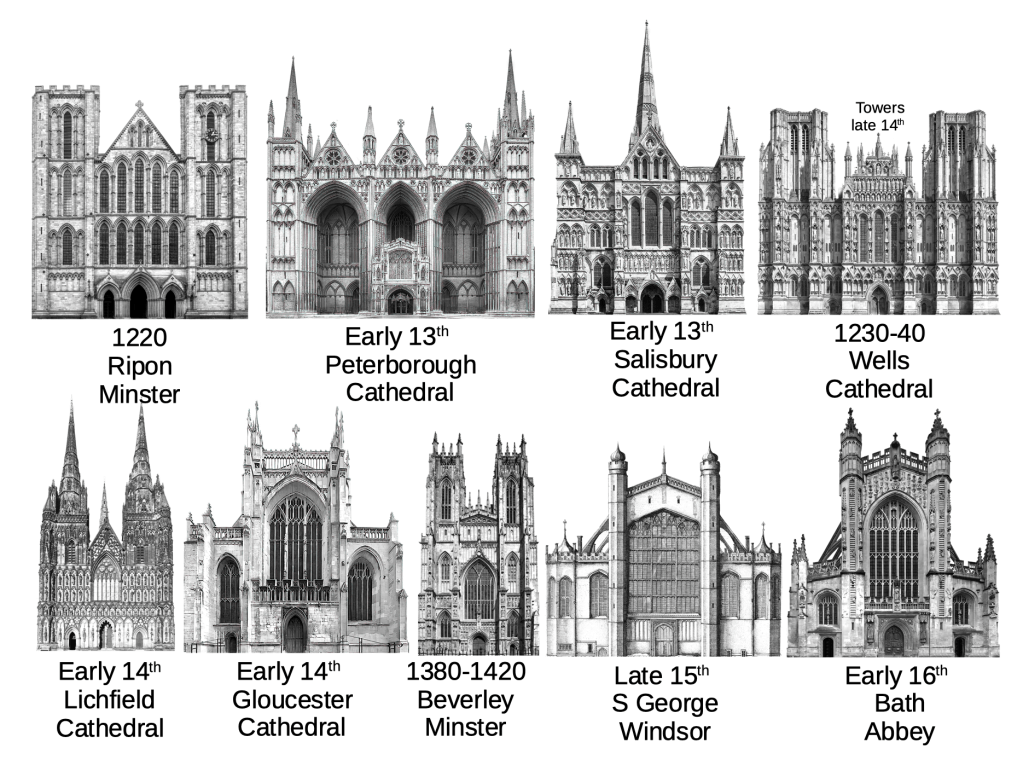
English gothic cathedrals were shorter than their French counterparts, often retaining the dimensions of the Romanesque naves they replaced rather than extending them to new heights. This gave their facades a more compact, squarish appearance, sometimes with side towers wider than the main cathedral body, as seen at Wells Cathedral. What the early English gothic cathedrals lacked in height they made up for in detail. Peterborough, Salisbury and Wells Cathedrals are filled with eccentric arcade patterns that don’t conform to any French prototypes.
English Gothic architecture is traditionally divided into three stages. The first, known as “Early English,” is characterized by the use of simple lancet windows, often arranged in rows, as seen at Ripon Minster. By the time Salisbury Cathedral was constructed, the “Decorated” style had emerged. This second phase introduced two-light windows, combining paired lancets with a rosette above, such as those flanking Salisbury’s portico. The final stage, known as “Perpendicular,” is exemplified in the windows of the last four churches illustrated above. This style was pioneered at Gloucester Cathedral which features a front window large enough to fill the entire center section of the facade. It contained long vertical shafts of “perpendicular” tracery that allow for much more expansive windows. The style was so popular that it can still be seen at S. George and Bath Abbey nearly two centuries later. The Gloucester-style facade even reappeared in the 20th century during a revival called “modern gothic” (fig. 28, First Baptist, Washington DC).
The facade at Beverley Minster illustrates an important development in the evolution of English Gothic. Its lower portions display the ornate detailing typical of Salisbury and Wells, while its upper portions adopt a more streamlined appearance. A similar transition can be seen in the late 14th-century towers at Wells Cathedral. These stylistic changes reveal the growing influence of continental and cosmopolitan trends, which gradually diluted the distinctly regional character of earlier English Gothic architecture.
Late French Flamboyant
Now that we have explored Gothic trends in England, Germany, and the Low Countries, we can return to France to examine how these influences shaped late Gothic French architecture.
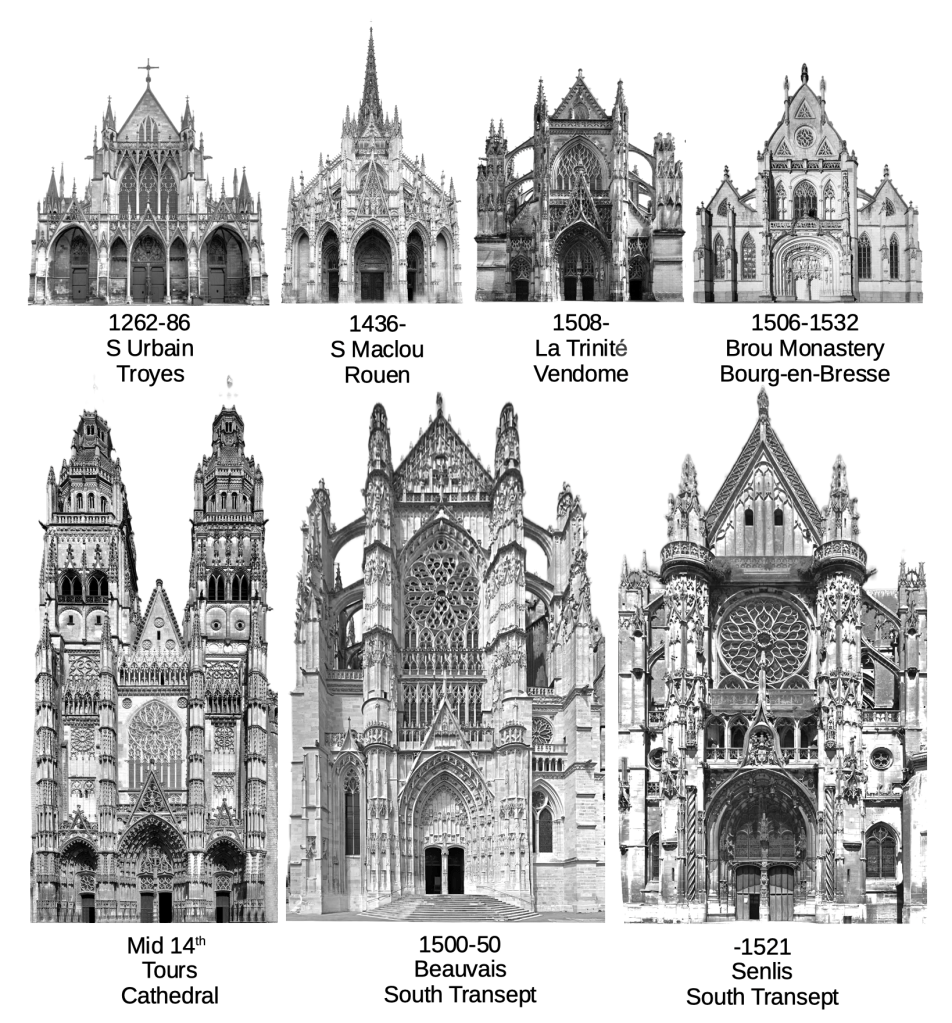
S. Urbain, constructed in the earlier Rayonnant style, was inspired by innovations at Reims Cathedral and S. Nicaise. This smaller collegiate church became a prototype for later French facade design. S. Maclou and La Trinité embraced the “Flamboyant” style, characterized by curvilinear tracery, ogee arches, pointy pinnacles, and steep gables—elements influenced by trends from Germany and the Low Countries. The large window at Vendôme reflects English Perpendicular tracery innovations (fig. 11), while the monastery at Brou demonstrates a proto-Renaissance aesthetic. Built by Belgian artisans, its facade shares a clear affinity with S. Paul in Antwerp (fig. 10).
The facade at Tours incorporates heavily coursed cylindrical towers, similar to those at Our Lady in Antwerp (fig. 10). These cylindrical towers also appear flanking the porticos of the transepts at Beauvais and Senlis, though in these cases, the towers are extended to greater heights. Tours’ facade includes the traditional French rose window, but it is integrated into a larger window featuring English Perpendicular tracery—a motif expanded further in the south transept of Beauvais, the cathedral with the tallest nave ever constructed, though ultimately left incomplete. The transept at Senlis takes a more experimental approach, with an enormous ogee arch over the portal and crockets on the undersides of its buttresses. This inventive style draws on the creativity of Brabant artisans, such as those responsible for the distinctive south transept at Hertogenbosch (fig. 10).
Spanish and Italian Gothic
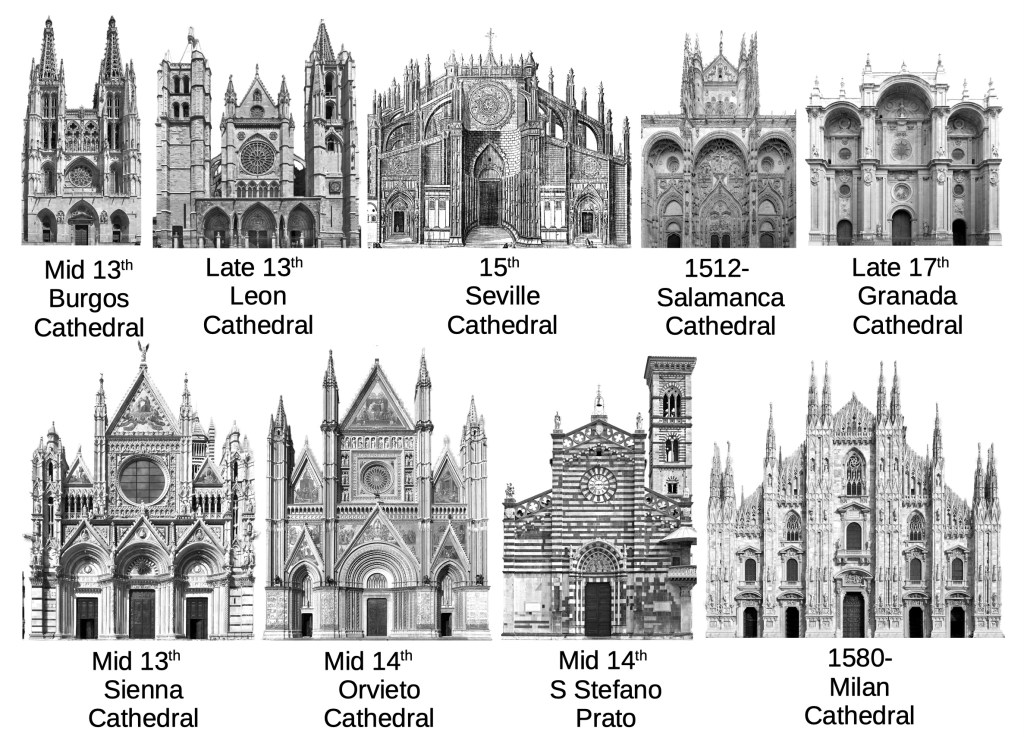
Spanish Gothic architecture was heavily influenced by French Gothic traditions, with many French architects contributing to Spanish building projects during the early Gothic period. The facade of Burgos Cathedral closely follows the style of Reims (fig. 9), while León Cathedral draws inspiration from Bourges. Spanish cathedrals were notable for their immense width, often featuring rows of chapels flanking the side aisles. Seville Cathedral is the largest cathedral in the world in both square footage and volume.
The late Gothic facade at Salamanca is built in the “plateresque” style, characterized by intricate, flat ornamentation inspired by the highly detailed metallurgy of altarpieces and reliquaries. This altar-like facade design set a precedent for the highly decorative facades of the Spanish Baroque period. The facade at Granada builds upon the Salamanca model while also incorporating Renaissance details into its design.
In contrast, Italian Gothic architecture rejected French influence, retaining the flat, gabled facade typical of earlier centuries, decorated with triangular versions of the pointed arch motif. The exception is Milan Cathedral, a monumental collaboration between French and Italian architects. While the interior of Milan Cathedral reflects the French Gothic tradition, its exterior facade retains the traditional Italian gabled silhouette with no attached towers. The doors and windows of the Milan facade are surrounded by classical aedicules in the Renaissance style dating from the 1580s. In the late 18th and early 19th centuries, Gothic revival pinnacles were added, giving the facade a hybrid gothic/classical appearance.
The Italian Renaissance Basilica
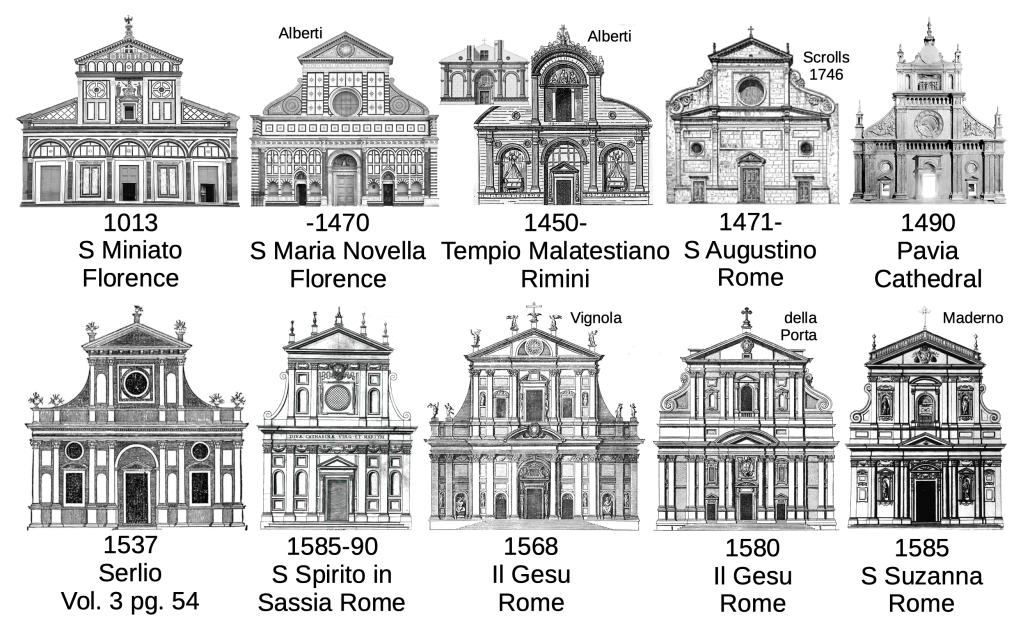
The archetypal church facade underwent a significant transformation in the 15th and 16th centuries. Italian Renaissance architects abandoned gothic motifs and looked to ancient Rome for inspiration. Architect Leon Battista Alberti revisited the polychromatic geometry of San Miniato (1013) in his famous S Maria Novella (-1470). At the time, San Miniato was thought to be an ancient Roman church, not a medieval one. Alberti’s unfinished Tempio Malatestiano took inspiration from Roman triumphal arches. Both S. Augustino and Pavia Cathedral were built on the prototype established by Alberti at S. Maria Novella. Pavia Cathedral articulated its facade with Lombard style dwarf galleries pioneered in the Romanesque period (see fig. 6, San Michele Pavia, Modena Cathedral). S. Augustino’s facade is articulated with sets of rectangular frames arranged in a somewhat arbitrary manner, but which foreshadow a design approach that was perfected by Sebastiano Serlio in his idealized facade from the third volume of his popular architectural treatise of 1537. S. Spirito in Sassia seems to have been directly modeled by Serlio’s drawing, only adapted to narrower proportions.
Vignola’s design for Il Gesù also built on Serlio’s prototype, albeit with additional sets of paired columns. The facade featured a projecting central portion, with recessed side portions, foreshadowing Baroque practices of the next century. Giacomo della Porta modified the facade at Il Gesù, rejecting Vignola’s arrangement of projection and recession, instead opting to keep the entire facade on a single plane. He also returned to the angled scrolls first seen at S. Maria Novella. Il Gesù served as the headquarters of the Jesuit movement, and its facade became a model for thousands of Catholic churches built during the Baroque period. For example, Santa Susanna, constructed a few years later, took the compositional motifs introduced at Il Gesù and gave them a greater vertical emphasis.
The Italian Renaissance Temple Front
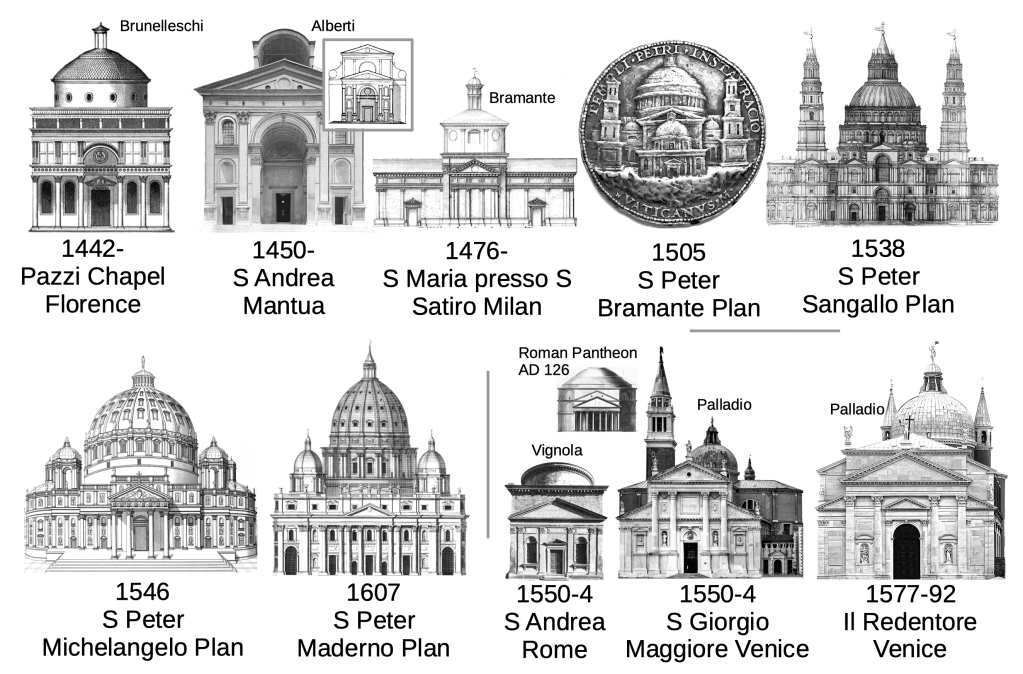
Renaissance architects began to incorporate Roman temple fronts into their facades particularly for domed churches built on central plans. The temple front (a gabled pediment placed atop columns) had been rejected by early Christians as too pagan, but during the Renaissance, it lost those associations and was embraced even in the rebuilding of St. Peter’s Basilica, the most important church in Christendom.
Historically, colonnades in Christian architecture had been arcuated (supporting arches) while ancient Roman colonnades were almost always trabeated (supporting flat architraves). But Brunelleschi reintroduced trabeated construction in the facade of the Pazzi Chapel (1442), which features a colonnade supporting an architrave rather than arches. Alberti’s S. Andrea, designed a few years later, added a gabled pediment supported by pilasters. However, it didn’t quite cover the top of the nave, the barrel of which was left uncovered. Alberti may have also intended to build a higher pediment on top, as illustrated in the conjectural drawing. Bramante’s eastern facade at S. Maria presso S. Satiro (1476-) made the temple front even more explicit. His unrealized design for the new S. Peter’s Basilica was memorialized on a coin minted in 1505 which contains a central temple front as well as elaborate sets of trabeated colonnades supporting multiple domes. Sangallo greatly expanded Bramante’s facade, creating a two-story colonnade crowned by multiple gabled pediments. Michelangelo simplified Sangallo’s exuberant plan in 1546, limiting it to a single projecting temple front. In Maderno’s final version of the facade, Michelangelo’s temple front is pulled back into a wider colonnade constructed on a single plane.
The various plans for S. Peter highlight the experimental nature of the Renaissance, which took classical architectural motifs and used them in innovative or “mannered” ways (hence the Renaissance sub-category “mannerism.”) However in the mid 16th century, architects Vignola and Palladio opted for a more disciplined approach to classical architecture. This can be clearly seen in Vignola’s S. Andrea, modeled explicitly on the ancient Roman Pantheon. Palladio was slightly more inventive than Vignola, but kept to the Pantheon theme. The Roman Pantheon contained two sets of gables, one placed rather irrationally on top of the other. Palladio rationalized the Patheon’s two-gable motif by lowering and lengthening the upper gable of the Pantheon prototype so that it now functioned as an angled eave for the side aisles of his church.
Italian Baroque
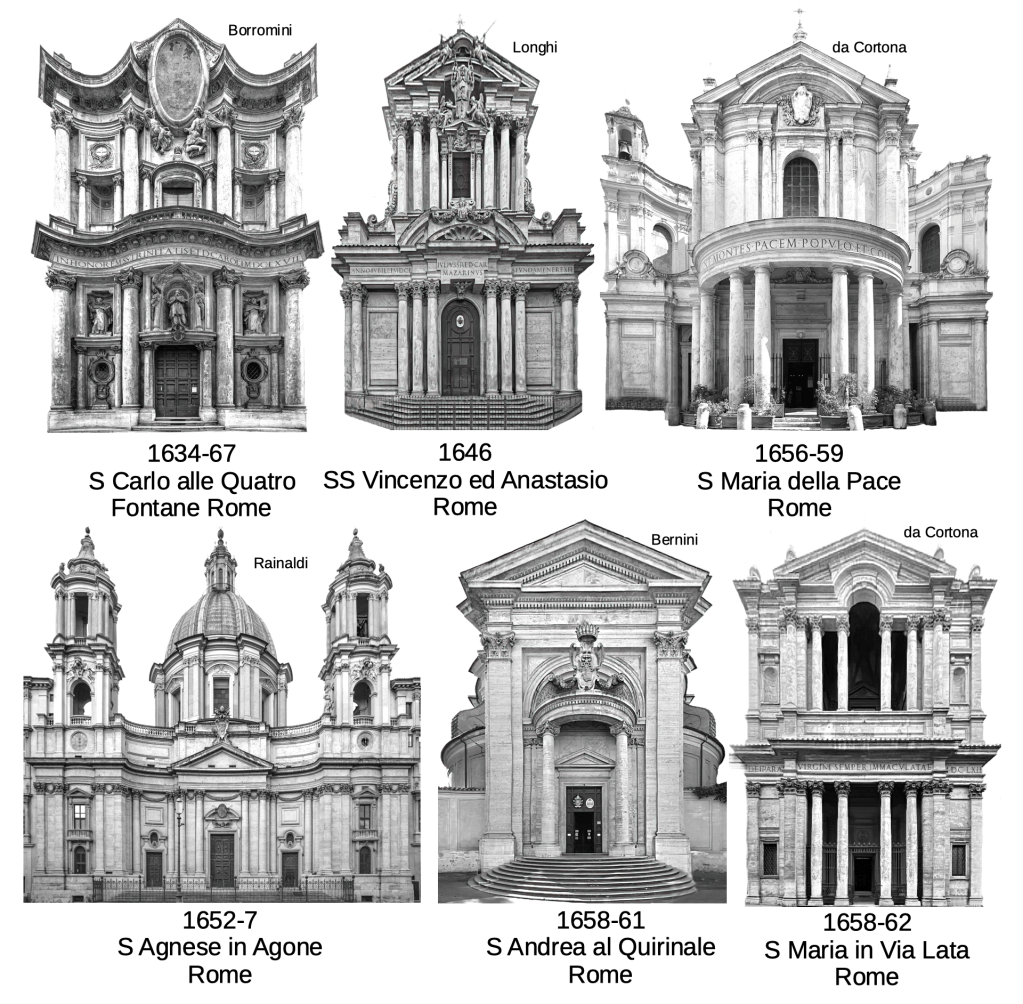
In the 17th century, Italian architects radically reimagined the church facade. They experimented with dynamic forms, breaking away from the traditional static geometry of earlier designs. They integrated complex curves, dramatic contrasts between solid and void, and bold spatial manipulations. The result was Baroque: a fluid and expressive architecture that emphasized movement and visual tension.
The convex and concave forms of Borromini’s S Carlo alle Quatro Fontane illustrate the curvilinear aesthetic of the Baroque period. While no other Italian architect dared go quite as far as Borromini, others still experimented with projection and recession to give their facades an energetic, sculptural quality. Most of these facades were too idiosyncratic to become prototypes in their own right, the exception being S Agnese in Agone with its prominent dome and flanking towers, which became an influential prototype in German and Spanish Baroque architecture.
French and German Baroque
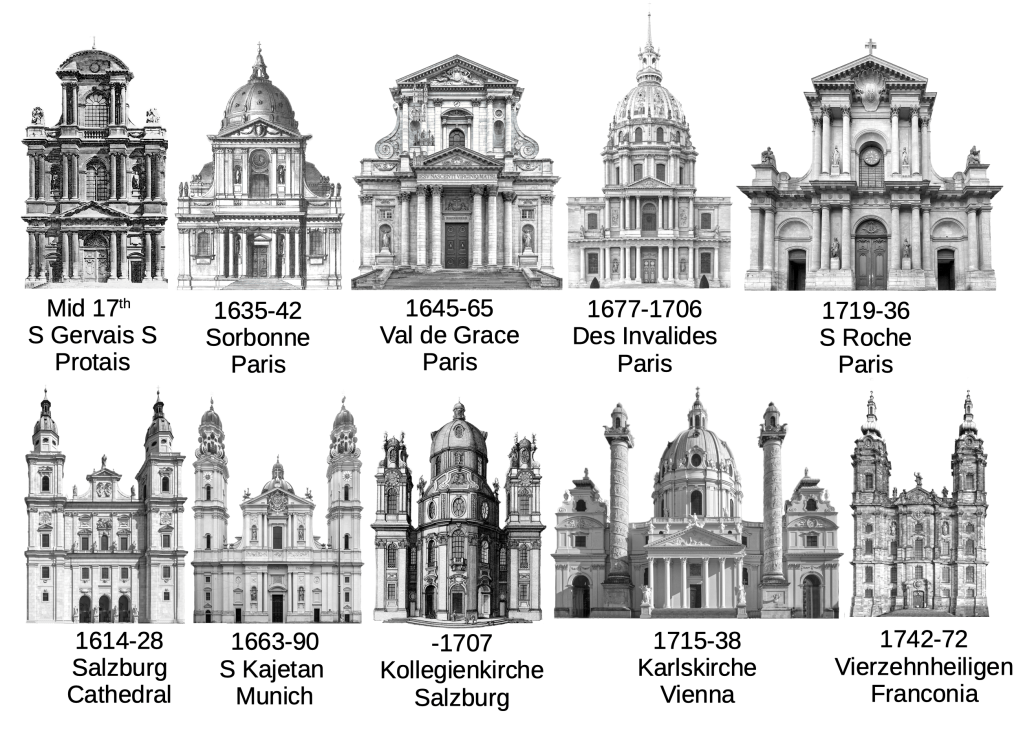
French Baroque architects rejected the wild designs of 17th-century Italians, favoring more elegant variations of Renaissance and Mannerist prototypes, particularly the model established by Il Gesù (fig. 14). Des Invalides goes even further, forgoing the usual Baroque scrolls linking the first and second floors, and instead opting for a strict “neoclassical” double portico, foreshadowing 18th-century architectural trends.
Salzburg Cathedral set the precedent for a double-towered Baroque style popular in German-speaking countries, also taken up at S. Kajetan in Munich. Apart from the added towers, these 17th century facades kept more or less to the sober mannerist prototypes exemplified by Serlio or Il Gesù. S. Kajetan does however contain a daring set of consoles surrounding each of its towers. In the 18th century, German architects adopted a an even more enthusiastic approach to Baroque experimentation as seen at the Kollegienkirche, which contains a unique concave towered central facade. Karlskirche in Vienna evokes S. Agnese in Agone (fig. 16), while introducing two monumental columns modeled on the ancient Column of Trajan. The emerging neoclassical influence is also evident in the church’s comparatively plain temple portico. Vierzehnheiliegen, built several decades later, features the highly detailed but less austere ornamentation associated with the Rococo period of the mid 18th century.
Spanish Baroque and Mission Style
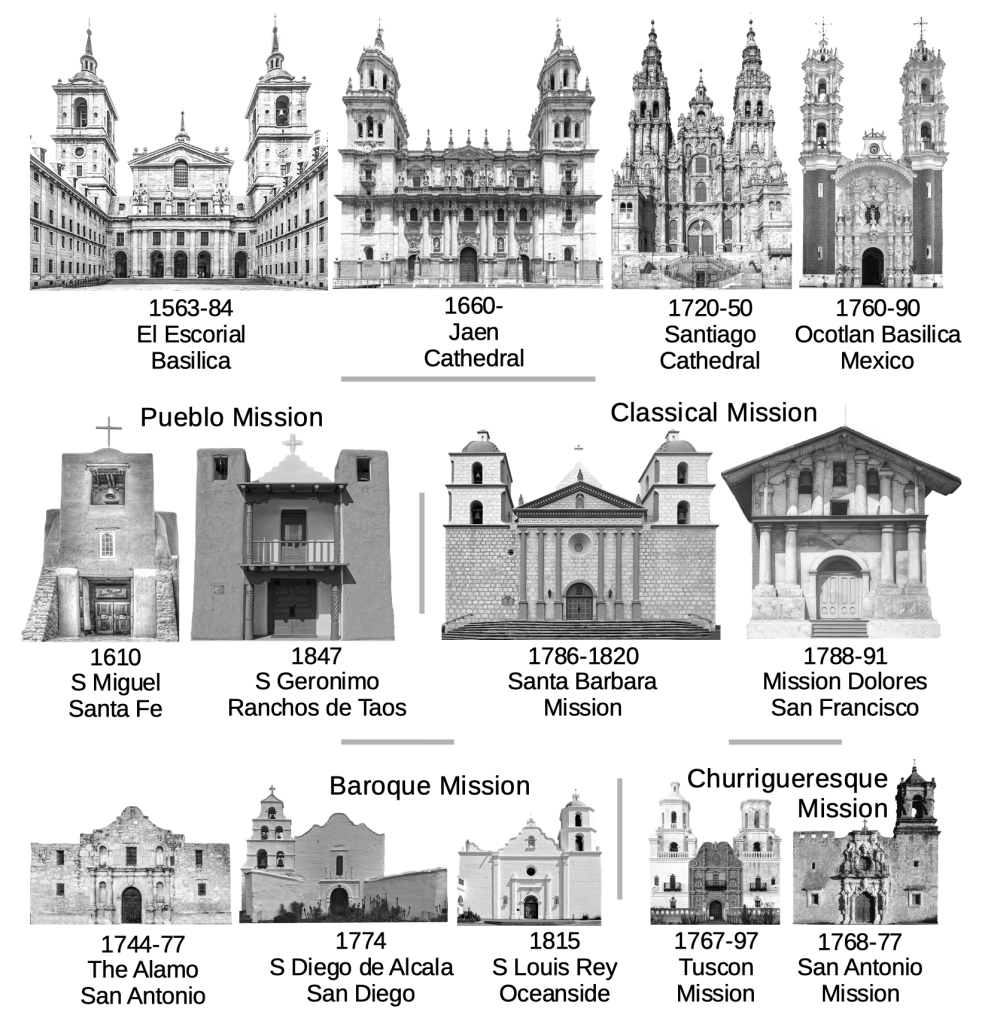
In figure 13, we noted that the evolution of Spanish Gothic architecture culminated in the exuberant ornamentation of the plateresque style. By the late 16th century, this style was rejected in favor of “desornamentado,” a pure Renaissance classicism exemplified in the basilica facade at El Escorial. Baroque elements emerged at Jaen Cathedral in the 1660s, and soon evolved into an exuberant form of Baroque called Churrigueresque, named after the sculptor José Benito de Churriguera. This style revisited the intricate ornamentation of 15th-century plateresque, but unlike the relatively flat appearance of plateresque, Churrigueresque is highly sculptural. At times, the style covers the entire facade, as seen at Santiago Cathedral, while in other instances, it fills only a section, creating the impression that the facade is a grand frame for a central altarpiece, as at Ocotlán Basilica. Churrigueresque had less in common with contemporary Italian and German Baroque ornamentation than it had with an earlier form of German mannerism popularized by Wendell Dietterlein in his famous pattern book of 1593 which contained ornamental fantasies reminiscent of the Churrigueresque style.
Spanish missionaries in distant parts of the New World had limited resources and little architectural education. They drew upon vague memories of Baroque churches from Spain to create an entirely new style of architecture. Their mission facades can be grouped into four architectural categories: pueblo missions, which borrowed Native American construction techniques; classical missions, featuring engaged columns and pediments; Baroque missions, characterized by an abstracted version of a Baroque central gable; and Churrigueresque missions, for those wealthy enough to employ artisans skilled in the ornamental style.
English Baroque
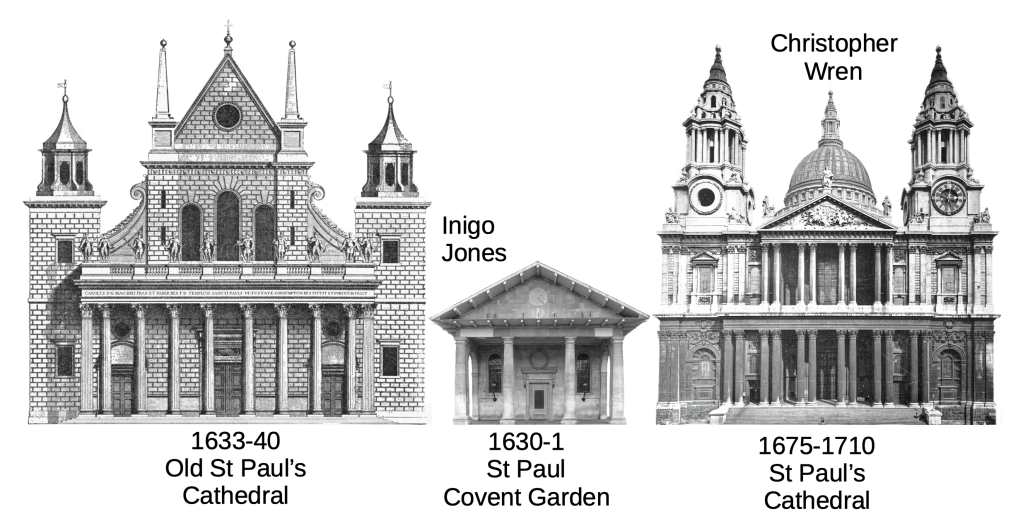
English Renaissance architect Inigo Jones designed a Baroque facade for the Cathedral of St. Paul in London, which combines mannerist motifs like the angled scrolls at Il Gesu (fig. 14) and the columned porticos at St. Peter’s Basilica (fig. 15). At St. Paul Covent Garden, Jones created a facade of radical simplicity, based on a strict interpretation of the imperial Roman architect Vitruvius. This austere classicism, which was extremely rare in the 17th century, would later be championed in the 18th century.
A few decades after Jones remodeled St. Paul, it was destroyed in the Great Fire of London. Christopher Wren rebuilt the cathedral with grander side towers and added a two-story, double-columned classical front with a dome, inspired by Les Invalides (fig. 17). This was Wren’s largest project, but as we shall see in the next section, the other smaller churches he rebuilt after the fire would have an even greater influence on the evolution of church architecture.
The Evolution of the English Steeple
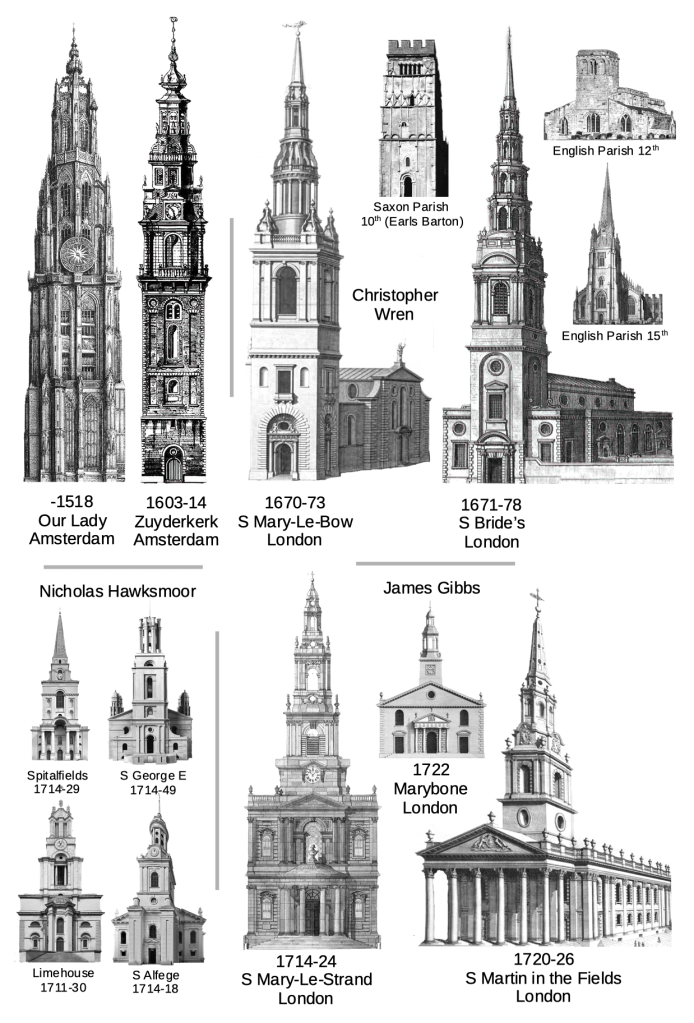
In the illustration above, we see churches that resemble thousands of steepled facades across the United States. Given their ubiquity, it’s worth exploring the origins of the classical steeple and tracing its development.
Like the single-towered German facades highlighted in fig. 3, England had a tradition of single-tower facades used in smaller parish churches, as seen in the illustration above with examples from the 10th, 12th and 15th centuries.1 When Christopher Wren was called upon to rebuild churches devastated by the Great Fire of 1666, he updated their gothic spires in a classical style. Wren took inspiration from the Flemish belfry tradition. We noted in fig. 10 that architects from the Low Countries dominated late Gothic architecture across Europe, building lofty, delicate spires that were added to the towers of many of the great cathedrals, including Our Lady of Amsterdam (-1518) shown in the illustration above. During the 16th century, Flemish architects began adding classical details to their delicate spires, culminating in De Keyser’s magnificent belfry at Zuyderkerk (1603-). Belfries like De Keyser’s were popularized in pattern books by Vrederman de Vries and others, and Wren would have been familiar with this tradition when he designed the steeples at St. Mary-le-Bow and St. Bride. A few decades later, architect James Gibbs helped popularize Wren’s steeple style through his own pattern books, which included designs for steeples at St. Mary-le-Strand, Marybone, and St. Martin in the Fields. These designs had a significant influence in colonial America.
It is also worth noting a path not taken: the steeples of Nicholas Hawksmoor. Even more striking and inventive, Hawksmoor’s steeples were rejected as models during the 18th century, which was focused on a pure, rational neoclassicism inspired by the 16th-century work of Antonio Palladio (fig. 15).
American Colonial and Federal

The earliest American steeples were simplified, terraced versions of those designed by Wren and Gibbs (fig. 20). Christ Church in Philadelphia was one of the first to incorporate an octagonal belfry. St. Paul’s in Halifax was modeled after Gibbs’ Marybone Chapel (fig. 20) and the steeple at First Baptist in Providence exhibits segmentation similar to that of Gibbs’ St. Mary-le-Strand (fig. 20).
Architect Asher Benjamin introduced a wider, triple-windowed portico at the Old West Church in Boston in 1806, topped by a simple cupola, similar to the Congregationalist church in Harwinton, which was built in the same year. In 1814, architects Ithiel Town and Charles Bulfinch added temple porticos to their designs for Center Church in New Haven and New South Church in Boston, a combination popularized by Gibbs’ S. Martin-in-the-Fields. Bulfinch, a particularly prominent architect (who contributed to the design of the U.S. Capitol), helped popularize Gibbs’ steeple style, ensuring its continued use for decades, as evidenced in the steeple of St. Paul’s in Richmond built during the 1840s.
Neoclassicism and the First Revivals
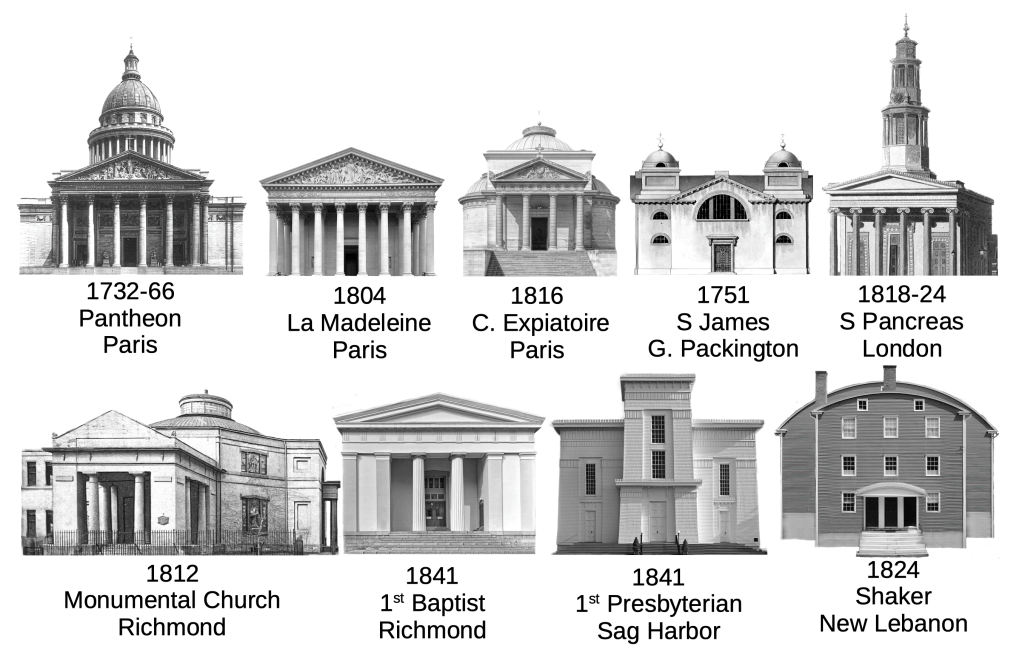
The architecture of the Pantheon in Paris was influenced by the “primitive hut theory,” a neoclassical idea that rejected Baroque ornaments, arches, and walls in favor of the purity of columns and beams. This approach sought an “authentic” architecture, supposedly practiced by our ancient ancestors. By the Napoleonic era, neoclassicism had devolved into the shameless copying of ancient structures, as seen in La Madeleine, modeled after the Temple of the Olympian Zeus, and the Chapelle Expiatoire, modeled on the Roman Pantheon.
In England, neoclassicism inspired works such as St. James in Great Packington, which features Diocletian windows drawn from ancient Roman bathhouses. St. Pancras, a renowned example of Greek Revival architecture, uses the Greek Ionic order with its large volutes and a steeple inspired by the Temple of the Four Winds in Athens.
By the early 19th century, the Greek Revival was in full swing in the United States. The Monumental Church and First Baptist in Richmond both utilize the austere Greek Doric order to create imposing primitivist facades. The Greek Revival was accompanied by an Egyptian Revival, as seen at First Presbyterian in Sag Harbor.
Shaker architecture shared neoclassicism’s emphasis on austerity, yet stripped of all traditional motifs. The Shakers created America’s first minimalist architecture.
Gothic Revival
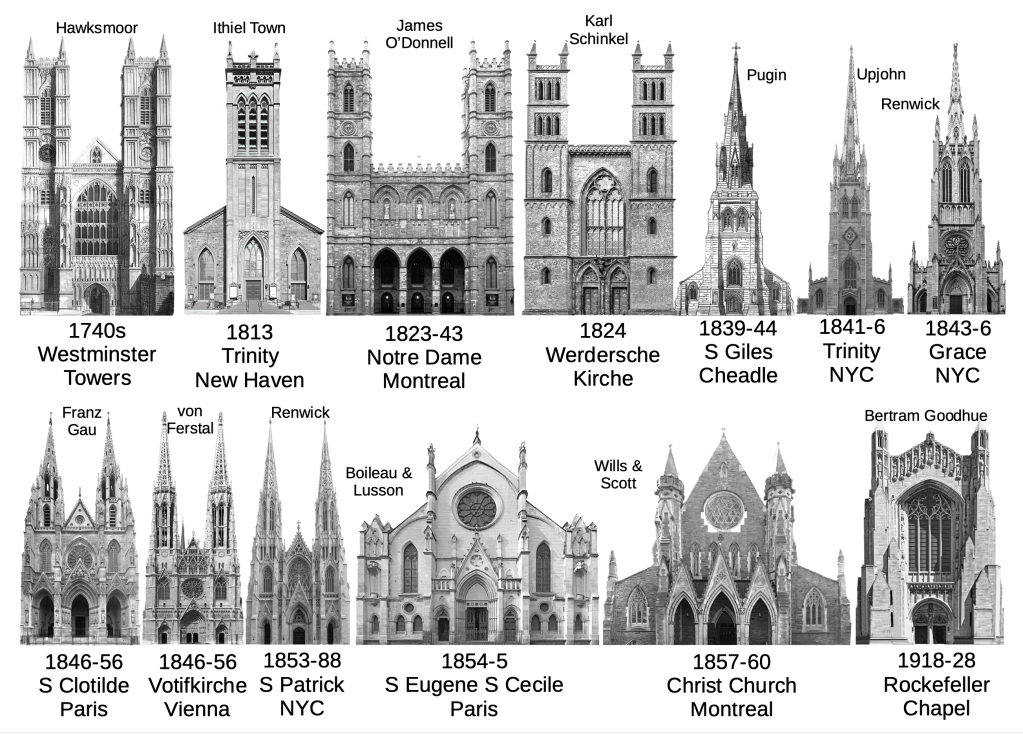
Greek Revival and neoclassical architecture were so ubiquitous in the early 19th century that it seemed like every building, whether a bank, a school, or a church, featured a temple front. This suffocating uniformity empowered romantic backlashes like Gothic Revival.
In the 18th century, there had been some early experiments in the Gothic style, like the gothicized classicism of Hawksmoor’s Westminster towers. By the early 19th century, architects like Ithiel Town began incorporating pointed arches into the traditional 18th-century front-steeple model. In the 1820s, box-like churches with flat Gothic ornamentation were built. By mid-century, detailed academic studies of medieval architecture had circulated widely, and architects like Nicholas Pugin, Richard Upjohn, and James Renwick designed churches based on English parish prototypes built in the Decorated Gothic style (fig. 20). These churches featured richly molded buttresses, which had been absent in earlier attempts. The French Gothic style was reintroduced in churches such as S. Clotilde, the Votivkirche, and S. Patrick’s (compare with Reims Cathedral, fig. 9). Additionally, a romantic, free-form Gothic emerged in churches like S. Eugene S. Cecile in Paris and Christ Church in Montreal. The Gothic Revival continued well into the 1920s, with the Rockefeller Chapel in Chicago, influenced by the Gothic Perpendicular style of Bath Abbey (fig. 11). The Rockefeller Chapel’s enormous cascading buttresses echoed the monumentality of the Art Deco period (fig. 27) in which it was built.
Romanesque Revival
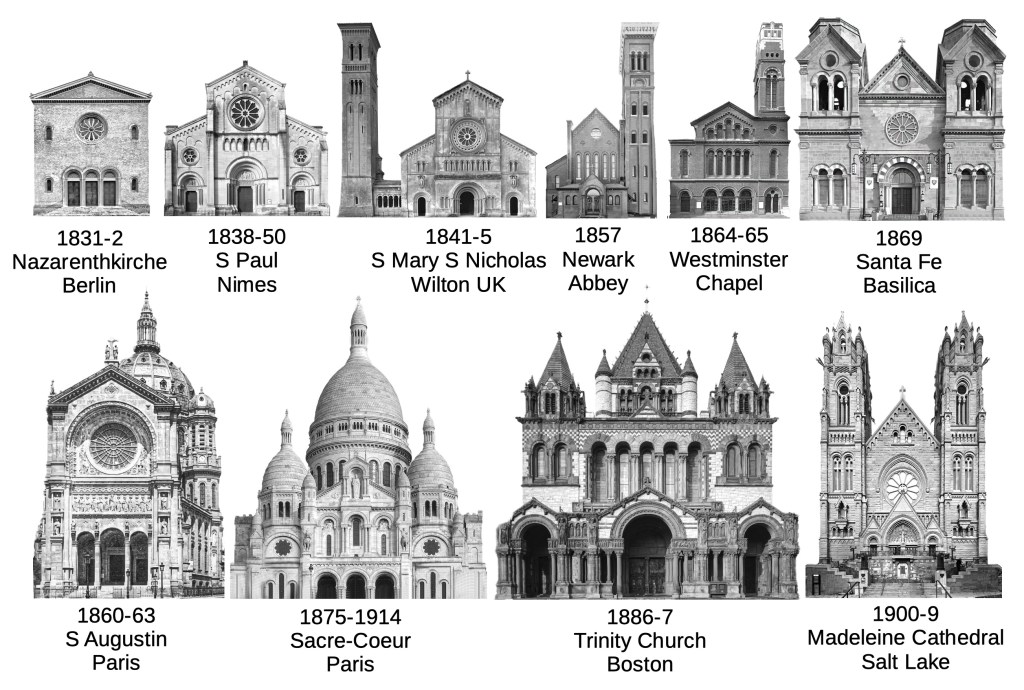
The Romanesque Revival emerged as an alternative to the Gothic Revival in the 19th century. Germany led the way with the rundbogenstil, or “round-arched style,” popularized by Heinrich Hubsche, who claimed that columns were an “architectural lie.” Other Early and mid-19th-century examples were inspired by Italian Romanesque styles (fig. 6), reflecting a broader interest in Italianate architecture during that period. The 1869 Santa Fe Basilica experimented with polychromatic brickwork, a technique that would be further developed in Henry Hobson Richardson’s Trinity Church in Boston. Trinity Church was so influential that it gave rise to a style of its own, Richardsonian Romanesque.
S. Augustin and Sacré-Cœur incorporated Byzantine motifs, reflecting 19th-century eclecticism and the Romantic fascination with ‘exotic’ styles. The Cathedral of the Madeleine in Salt Lake City blends Romanesque arches with Gothic gabled porticos, typical of the hybrid approach to architecture in the early 20th century.
Arts & Crafts, Art Nouveau
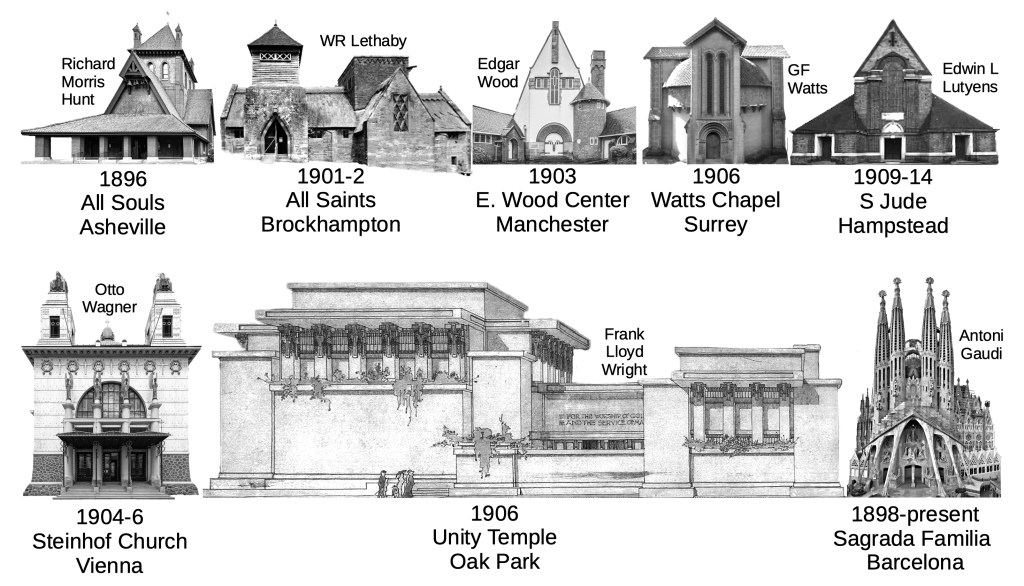
The Arts and Crafts movement was a backlash to High Victorian architecture and its celebration of industry and modern building materials. Rural, cozy, and quirky, most Arts and Crafts churches never gain widespread popularity. However, their steeply pitched rooflines foreshadowed the A-frame craze of the 1950s and ’60s (fig. 30).
Art Nouveau church architecture was more cosmopolitan and sophisticated, though its appeal was also limited. The exception was Frank Lloyd Wright’s Unity Temple, which played a pivotal role in launching the Prairie style in domestic architecture. The Sagrada Familia Cathedral, often classified as Art Nouveau, is set to be completed in 2026—a rare modern cathedral being constructed on a medieval timescale.
Spanish Mission Revival
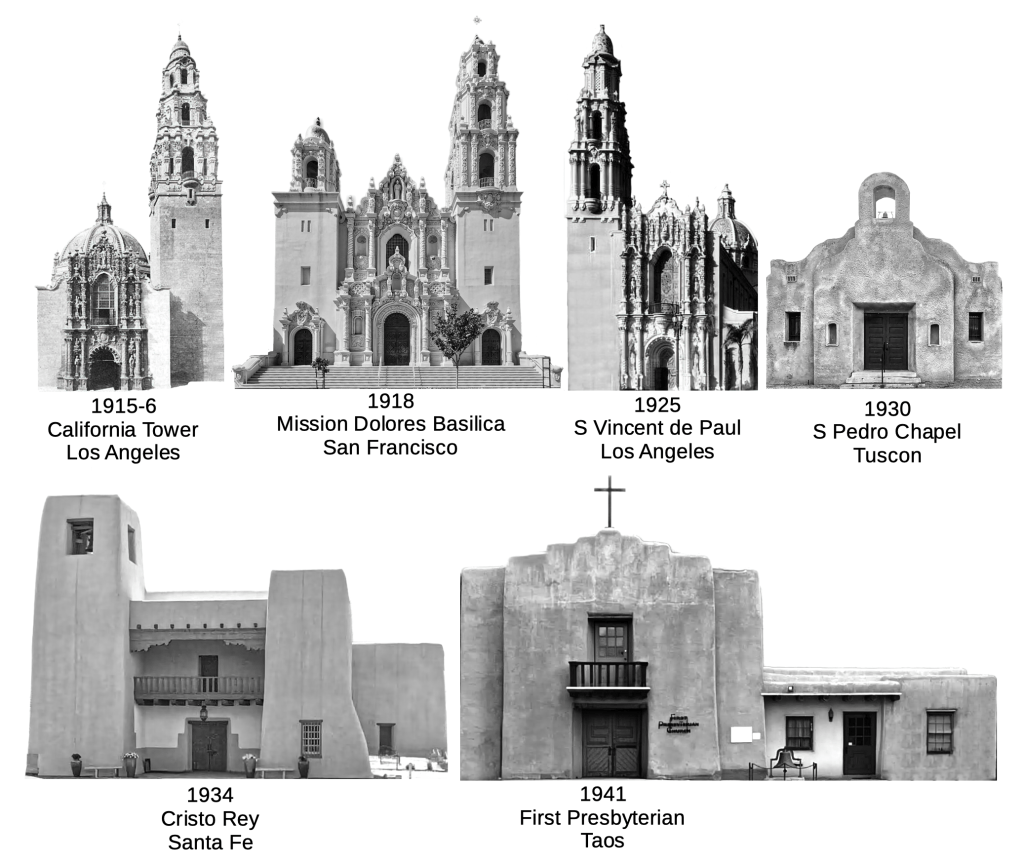
“The Panama-California Exposition in San Diego in 1915 sparked a Spanish Mission Revival in the United States. While the majority of buildings in this style were civil, commercial, or residential, a few prominent churches were constructed, including Mission Dolores in San Francisco and St. Vincent de Paul in Los Angeles. Precedents for both can be seen in the 1760 Ocotlán Basilica (fig. 18), with its mix of plain plaster walls and highly ornamented Churrigueresque panels. In the 1930s, a revival of smaller-scale pueblo mission-style churches emerged in the Southwest United States.
Art Deco
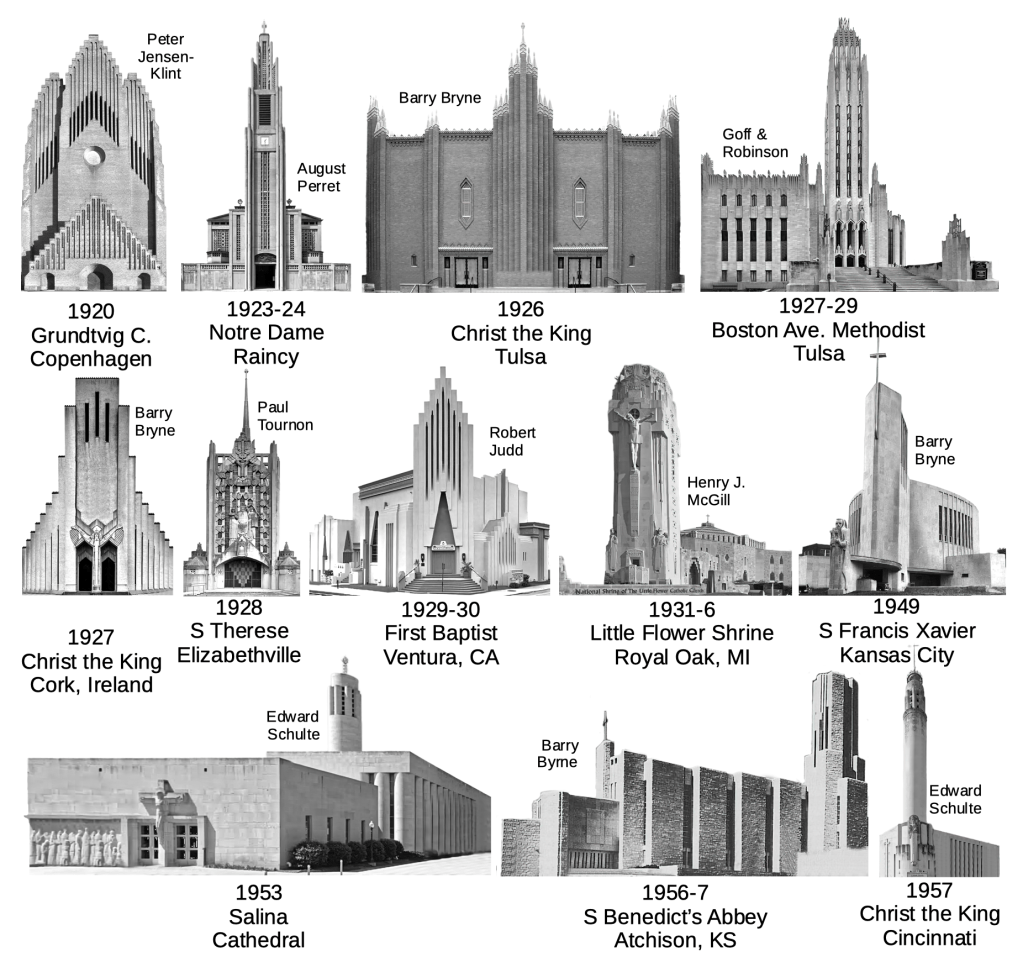
In the 1920s, Art Deco church facades featured layers of flat vertical planes arranged into dynamic, pyramidal structures. After 1930, sculptural massing took on greater significance, as seen in the Shrine of the Little Flower and St. Francis Xavier. Edward Schute introduced massive cylindrical towers reminiscent of granaries, while Barry Byrne used abstract, coarse masses in a bold, primitivist design at St. Benedict’s Abbey.
Modern Gothic
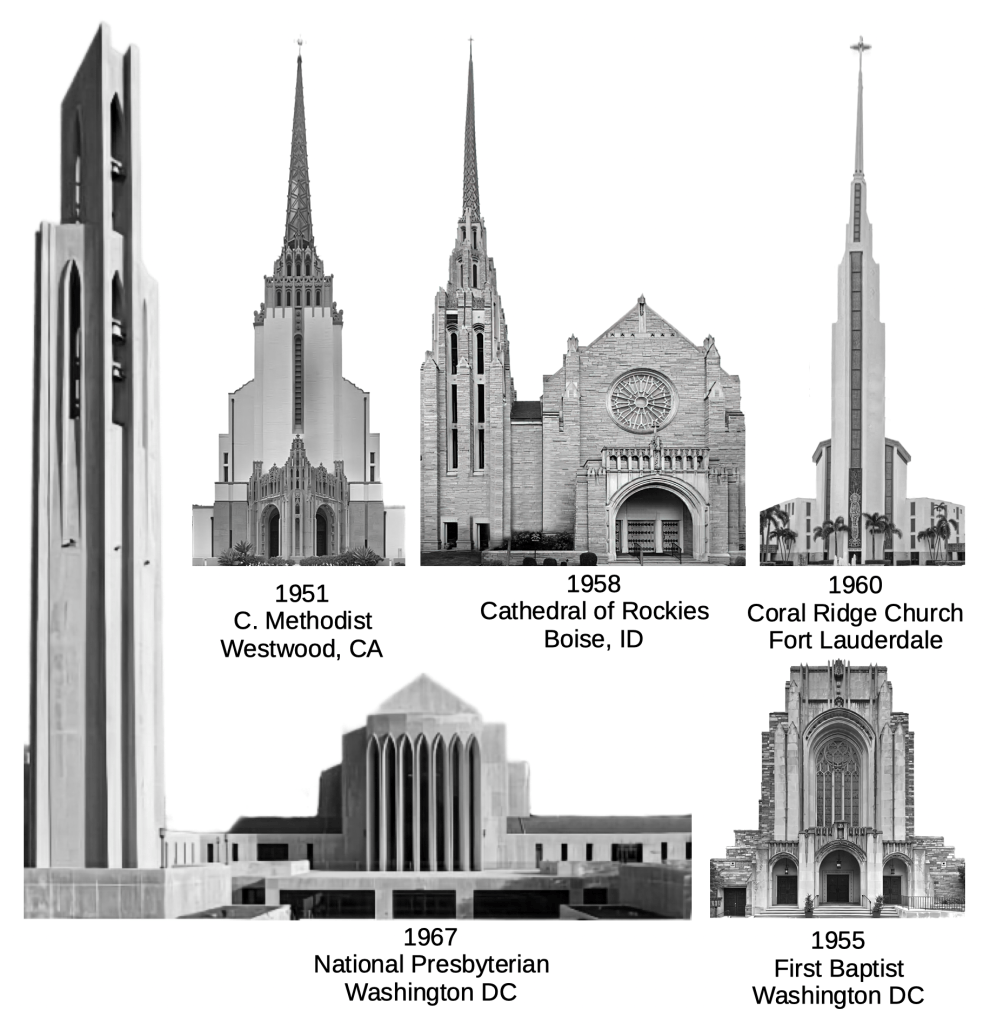
Art Deco, with its stepped, pyramidal designs, shares an affinity with Gothic architecture’s stepped buttresses (see fig. 23, Rockefeller Chapel). Both styles also share a towering monumentality. Harold Wagoner, a leading mid-century church architect, blended Art Deco with Gothic to create ‘Modern Gothic.’ Westwood Methodist combines an Art Deco tower with a richly decorated Gothic portico and spire. The dramatic spire at Coral Ridge evokes Gothic forms even without explicit traditional motifs. National Presbyterian merges 1930s Art Deco monumentality with the pointed arch motif, while First Baptist presents a dramatic interpretation of the Bath Abbey prototype (fig. 11), as seen at Rockefeller Chapel.
International Style
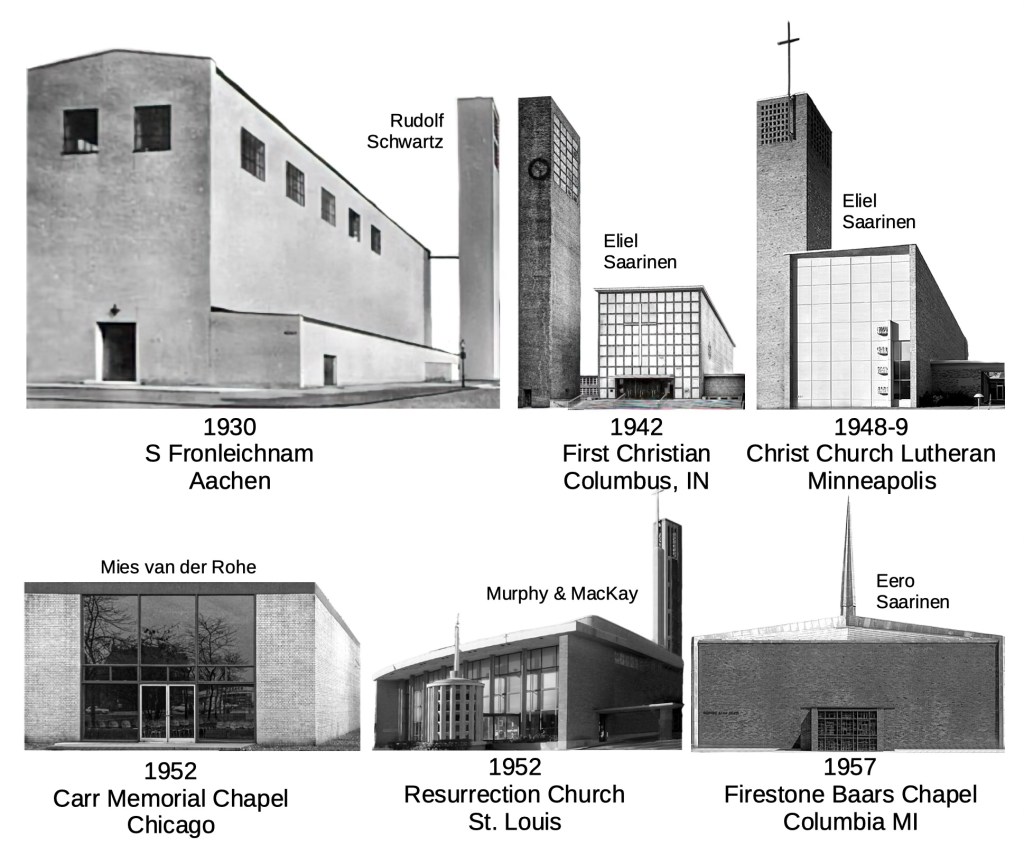
While the monumental, dynamic forms of Art Deco and modern gothic architecture drew inspiration from earlier styles, minimalist architecture of the 1950s rejected traditional styles altogether. Churches built in the International Style, such as those by Rudolf Schwarz and Eliel Saarinen, still retained elements that made them recognizable as churches, like square towers and rectangular naves. However, the Carr Memorial Chapel severs the connection completely. The facade was stripped of any motifs that might suggest its function, and other minimalist churches of the 1950s followed suit, leaving only the most perfunctory spires to hint at their sacred purpose.
A-Frame
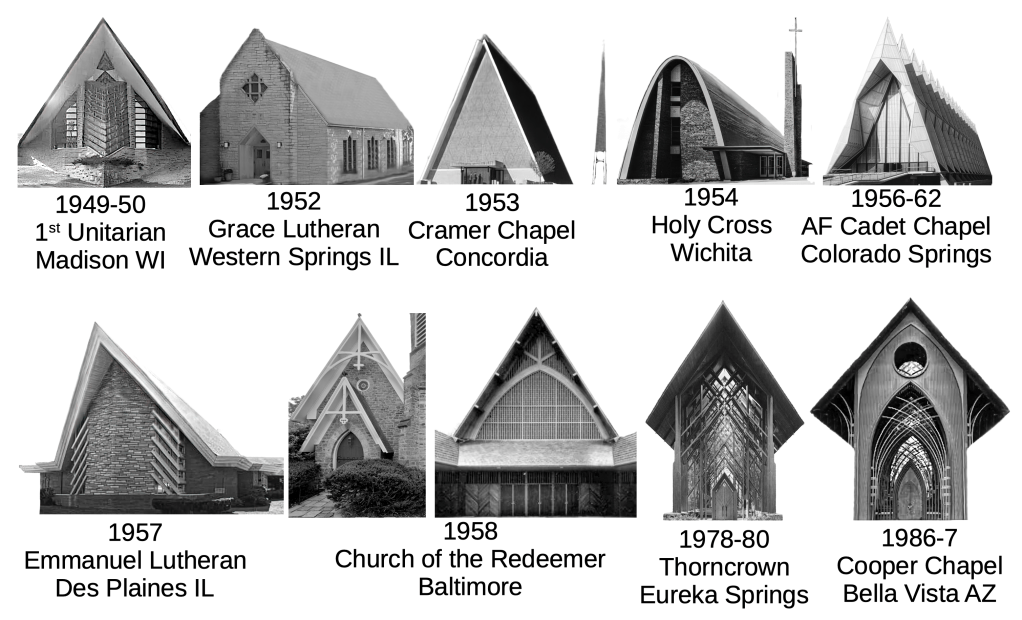
The A-frame emerged as a practical solution to the dilemma the International Style faced in maintaining a “church-like” appearance. Its pointed silhouette evoked the gothic spirit, directing the viewer’s gaze to the heavens. Additionally, the A-frame was cost-effective, making it the ideal choice for expanding congregations in the 1950s and 60s, who sought a modern design that still looked like a church. This approach paralleled the cost-saving strategies of Gothic Revival churches such as Grace Lutheran (1952), which extended their rooflines to reduce construction expenses. At the Church of the Redeemer in Baltimore, Pietro Belluschi remodeled a 19th-century Gothic Revival chapel with modern A-frame additions, highlighting the shared ethos of Gothic and modern.
Frank Lloyd Wright’s First Unitarian (1949) was the first modern A-frame of this period, although the similar designs had been used in turn-of-the-century Arts and Crafts churches (fig. 25). Wright’s version, with its sleek, angular lines, evokes the grill of a luxury car from the period, imbuing the structure with a dynamic, techno-optimist energy. Charles Stade created a toned-down version of Wright’s facade at Emmanuel Lutheran in 1957.
Not all A-frame churches were built on the cheap. The artistic potential of the A-frame was brilliantly showcased at the Air Force Cadet Chapel, a tour-de-force of 20th century architecture.
In the late 1970s and 80s, the A-frame was rebranded as an eco-friendly symbol, exemplified by Fay Jones’ Thorncrown and Cooper Chapels, highlighting its harmony with nature.
Modern

Today’s Christians lean conservative in their architectural preferences and politics. So it comes as a surprise that Christian congregations in the 50s and 60s were willing to hire such avant-garde architects. Post-war Christians had embraced a technological and theological progressivism, believing that Christianity was a religion for the future, not just the past.
While many of these churches now appear dated, more “modernistic” than modern, they were nevertheless heroic attempts to capture the spiritual ethos of the era. The same cannot be said about the next stage of church development.
Non-Church
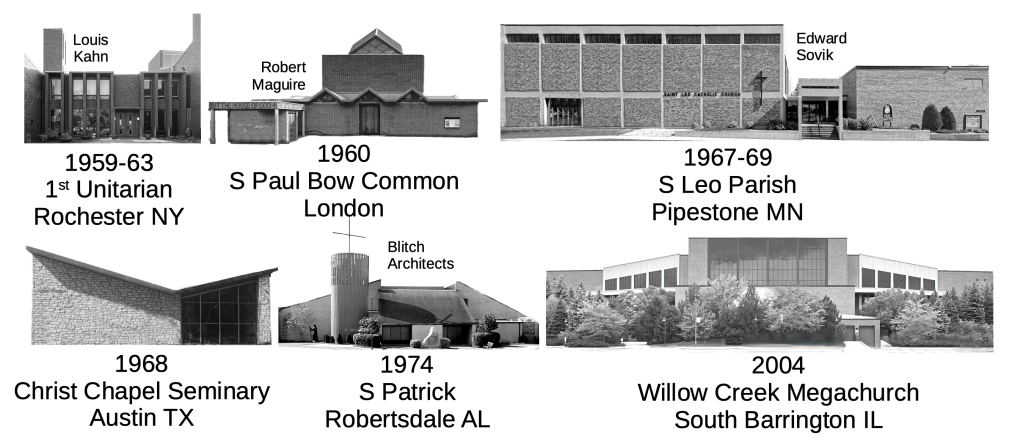
In the late 60s and 70s, declining membership and social malaise sparked an identity crisis in Christianity. Congregations turned away from exuberant space-age architecture in favor of a more sober style, redirecting financial resources to social gospel work and community outreach. Architect Edward Sovik coined the term “non-church” to describe this new design approach, which rejected the traditional axial nave/altar orientation in favor of centralized plans that emphasized the communal aspects of worship.
In the 80s, the evangelical movement grew rapidly and many of the new evangelical churches adopted the architectural preferences of the “non-church” social gospel churches from the 70s. Even today, many evangelical churches resemble offices, warehouses, or stadiums, such as the Willow Creek Megachurch.
Post Modern
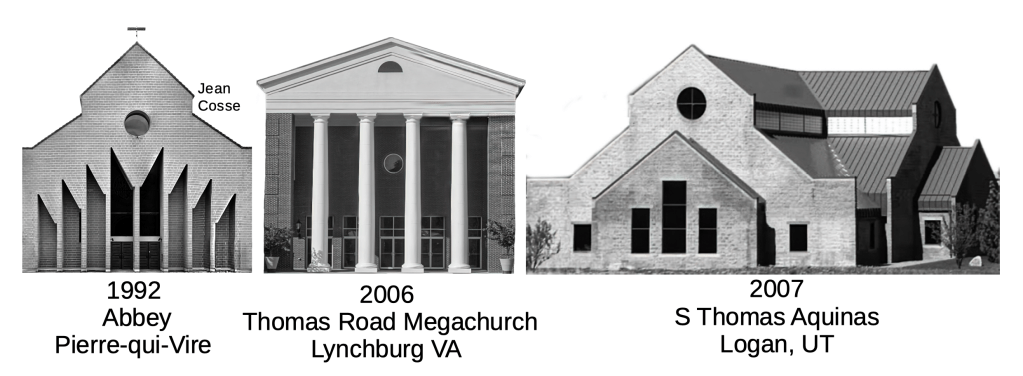
Post-modernism emerged as an alternative to the “non-church” approach. Architects began reintroducing traditional motifs, albeit in a simpler, more abstracted style. At its best, this approach reimagined traditional elements in fresh, insightful ways, as at the Pierre-qui-Vire Abbey. However, much of post-modern church architecture was little more than a lazy form of classicism, exemplified by Thomas Road Baptist Church. The portico of this megachurch contains a diminutive fanlight perched at the top of its pediment, perhaps as a nod to the Jeffersonian classicism of nearby Monticello. The design of St. Thomas Aquinas in Logan strikes a good balance between modernism and traditionalism, using basic geometric shapes to subtly evoke an aisled basilica.
Abstract, Conceptual

Some of the modern exuberance seen in church architecture during the 1950s and 60s continued into the late 20th century, notably in the work of Philip Johnson (fig. 34, top three churches). Even without relying on traditional religious motifs, Johnson’s churches evoke a transcendent spirituality. The Chapel of Thanksgiving is designed around a spiral, symbolizing the universal beauty of the Fibonacci sequence. The Crystal Cathedral reimagines the church as a Mount Sinai of glass. The Cathedral of Hope Chapel arranges organic forms into a harmonious hierarchy. All three structures are designed on the presumption that transcendent ideals of beauty exist and can be universally grasped.
The same can’t be said of the lower four churches illustrated in figure 34. These churches present abstract arrangements that can only be understood “conceptually,” requiring knowledge of the theoretical foundations behind the architect’s design choices. Given the fact that contemporary architecture has abandoned the notion of a universal aesthetic in favor of a conceptual one, it’s not surprising that a strong traditionalist backlash has emerged in “New Classicism.”
New Classicism
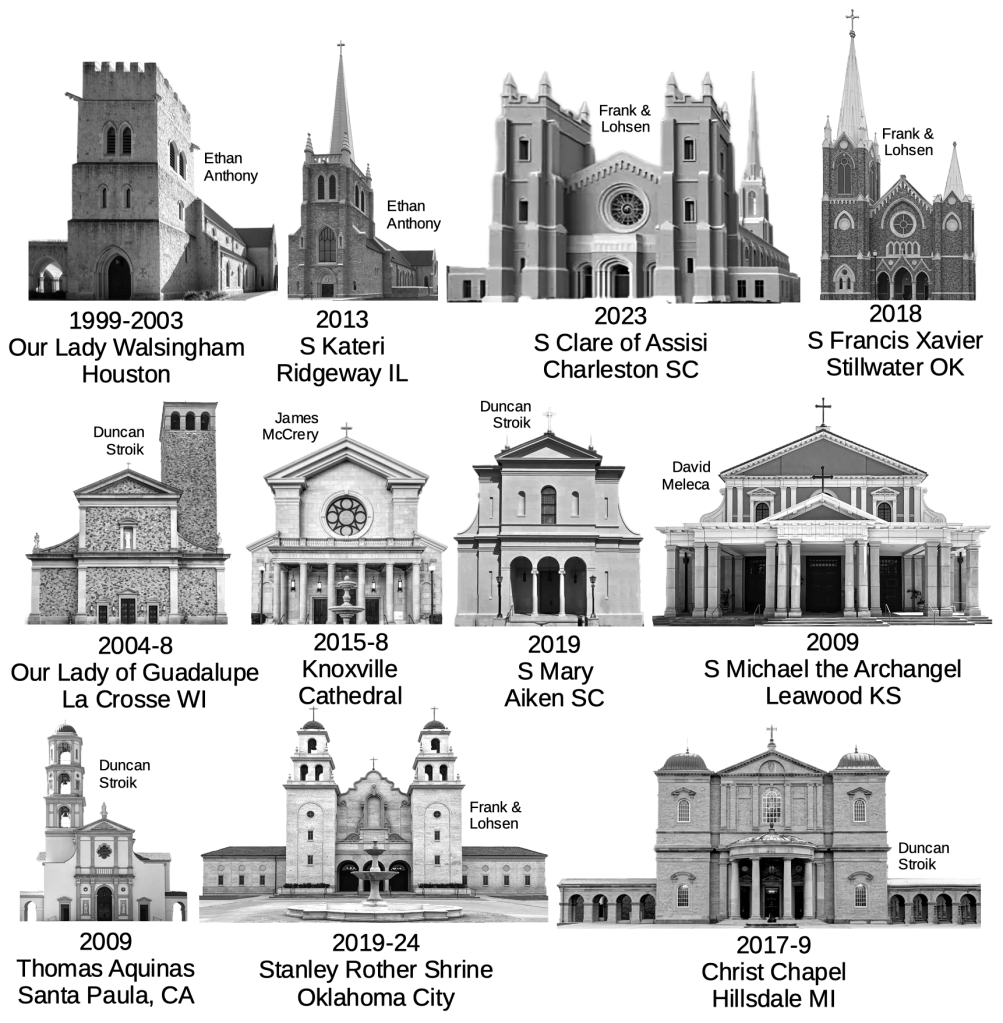
The New Classicist movement offers a disciplined antidote to the sloppy traditionalism of the post-modern architecture exemplified by Thomas Road Baptist Church (fig. 33). Ethan Anthony and Frank & Lohsen have built churches in a gothic style, so perhaps they shouldn’t be categorized as New Classicist. Yet they share the same historically informed approach to design. Our Lady Walsingham in Houston features a castellated tower inspired by Norman churches in the Walsingham area of Norfolk, England, while St. Kateri draws closely on the English parish church tradition.
St. Francis Xavier utilizes a brick gothic style originally developed in Northeast and Central Europe in the 13th century. Polychromatic brickwork was popular during the mid-19th century High Gothic Revival due to the influence of John Ruskin and his promotion of polychromatic Venetian Gothic architecture from the 14th century. (See the 1868 Cathedral Santuario de Guadalupe in Dallas). The façade of St. Clare of Assisi in Charleston features two massive Gothic towers protruding from the portico, a design typically seen in Spanish Mission (fig. 18) or Sicilian Romanesque architecture (fig. 7), but unusual in Gothic architecture. This makes St. Clare an interesting hybrid. Frank & Lohsen used a similar design at the Stanley Rother Shrine, although in a Spanish Mission style.
Italian Renaissance influences are particularly popular in New Classicism. Our Lady of Guadalupe’s façade echos San Biagio, while St. Mary in Aiken appears to be inspired by the Renaissance façade of St. Ambrogio della Massima. Knoxville Cathedral’s overall silhouette resembles early Renaissance prototypes. However it also features a colonnaded portico with a balustrade (Palladian-ish, see fig. 19, Old St. Paul’s) and a pediment with a cornice return mounted on wide pilasters (Greek Revival). St. Michael the Archangel in Leawood presents a somewhat wider version of the Mannerist façade of St. Susanna (fig. 14), albeit in a polychromatic setting and featuring a projected portico.
The Chapel at Thomas Aquinas College is clearly built in the Spanish Mission style. Similar façades can be found at Santa Barbara Mission (fig. 18) and the Catedral San Felipe Apostol in Puerto Rico, which are both decorated with simple polychromatic arrangements of pilasters. Blessed Stanley Rother Shrine has a beautiful Mission-style gable highlighted with its own special molding, framing a simple yet lyrical Baroque arch. These details make this façade a particularly elegant addition to the Spanish Mission architectural tradition.
Duncan Stroik’s Christ Chapel at Hillsdale evokes an 18th-century Palladian villa with its lower attached wings (see Morris Select Architecture, plate 16). The main gable features the Serliana motif, another Palladian reference. The towers are built at the same height as the rest of the façade, which makes it look more like a stately home than a church. The tower windows, crowned by decorative pediments (both gabled and segmented), all feature turned corners (Greek revival), which is a unique touch. The rounded portico recalls Benjamin Latrobe’s Ashdown House or even the White House in Washington DC. Overall, it’s an elegant arrangement that blurs the line between church and home, with strong references to 18th-century Palladianism, fitting for Hillsdale College’s emphasis on classical education in the Enlightenment tradition.
Conclusion
The New Classicist movement is a backlash to the overly abstract forms of modernism and the aesthetic groundlessness of postmodernism and conceptualism. The 19th-century revival movements (fig. 23, 24) were also reactions to the austerity of neoclassicism, which was seen to have become detached from the true purpose of church architecture. The 19th century revivals were criticized as overly derivative, but they nevertheless sparked new and inventive forms of architecture. Today’s New Classicism adheres closely to past styles like Spanish Mission and Italian Renaissance.
Where will church architecture go from here? I suggest revisiting the inventive classicism of 18th century architect Nicholas Hawksmoor (fig. 20). His work was rejected by the neoclassicists and largely forgotten, but his approach to architecture provides an interesting model for how to work within a revival style. Hawksmoor knew the rules and traditions of classical architecture and could create orthodox versions that would please purists. But he could also break the rules in ways that were innovative and inspiring. His architecture points to “roads not taken.” One can imagine an alternative 18th century filled with imaginative Hawksmoor-ian spires. Maybe such a landscape will be built one day.
- Pre-Norman England had a type of parish called tower-nave, fronted by an imposing tower with Anglo-Saxon ornamentation with an attached single aisle nave. ↩︎
 Evolution of Architecture
Leave a comment