Circles and Octagons

Early Christian church architecture included not just rectangular basilicas, but also mausoleums, martyria, and baptistries built on central plans. Early Christians saw the octagon as a symbol of the resurrection and the circle as a symbol of eternal life. Baptistries were built to resemble mausoleums because the ritual of baptism was also a symbol of death and rebirth.
Circular mausoleums were common in the ancient world, particularly among the Etruscan ancestors of the Romans, who built large circular burial mounds. Over time, Roman mausoleums became increasingly elaborate and decorated, as seen in the 1st c AD mausoleum Le Carceri Vecchie.1 The pagan mausoleums of Diocletian and Maxentius contain important precedents for later Christian architecture. Diocletian’s mausoleum is octagonal, with an outer colonnade and a set of seven inner apses or exedrae. Maxentius’ mausoleum is built with a barrel vaulted outer ambulatory surrounding an inner core featuring eight exedra. Early Christians adopted Diocletian’s octagon but rejected its outer colonnade in favor of an inner colonnade resembling Maxentius’ ambulatory. All the Christian examples in figure 1 feature one or even two ambulatories (S. Stefano) surrounding a central domed core.
Greek Cross
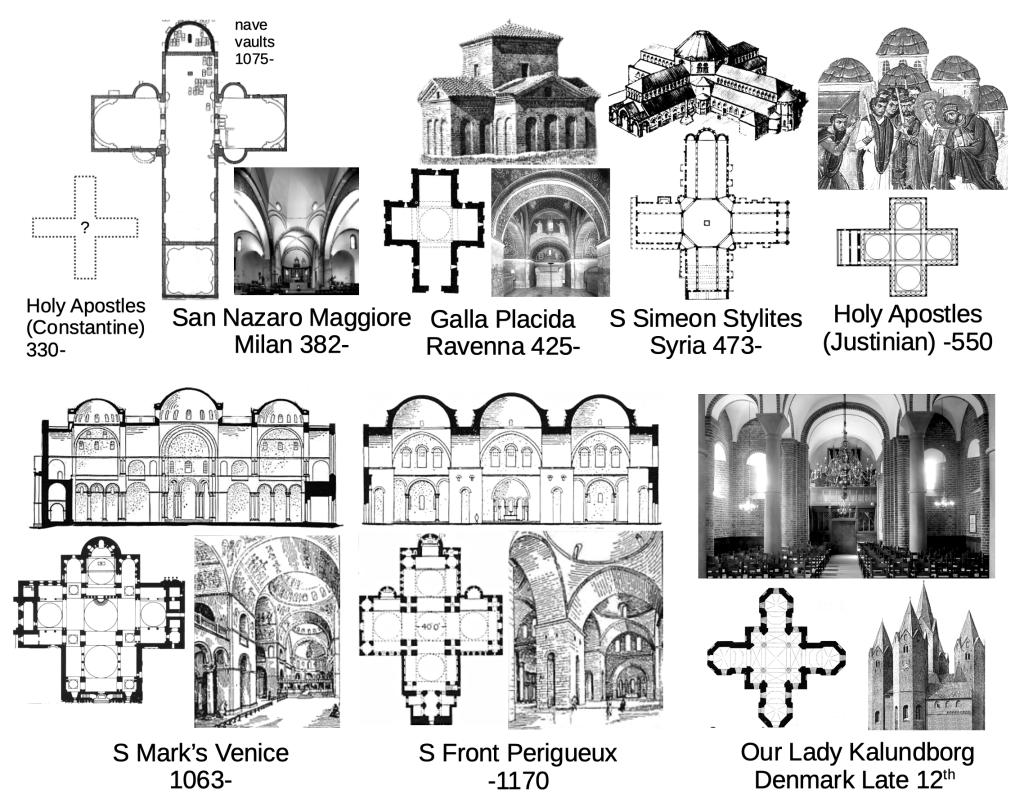
A Greek Cross is a cross with arms of equal length. The first Greek Cross plan was likely the now lost Church of the Holy Apostles in Constantinople (330-). A contemporary account describes this church as a cruciform structure with a high central dome. It may have resembled S. Nazaro Maggiore in Milan (832) or S. Simeon Stylites (473-), which were said to have been modeled on the Church of the Holy Apostles. S. Nazaro was remodeled significantly in the 11th century and S. Simeon Stylites only exists as a ruin. The Church of the Holy Apostles itself was expanded by Justinian (-550), who added domes on each arm of the cross. The earliest cruciform plan that still exists in its original state is the Galla Placida mausoleum in Ravenna (425-).
Even though Justinian’s five domed Church of the Holy Apostles has been lost, we can get a sense of what it might have been like when we enter S. Mark’s Venice (1063-) and S. Front Perigueux (-1170), which were both inspired by it. Our Lady of Kalundborg Denmark (late 12th c.) was also built on a Greek Cross plan, albeit without domes.2
Cross in Square

In the Byzantine world, cruciform plans were largely abandoned in favor of the cross-in-square plan, where a cross-like inner space is inscribed within an outer square. Pagan precedents for this plan can be seen at the Roma Al-Mismieh Temple (164-). One of the earliest Christian examples was Trier Cathedral (340-), although it has since been replaced by a much larger structure. An original 5th century cross-in-square church has survived at Etchmiadzin Cathedral in Armenia (483-), although somewhat remodeled.
Bosra Cathedral (513-) and S. George Izra (515-) contain modifications of the cross-in-square plan: each arm of the cross was reoriented so that the apse ends (exedrae) of the cross arms were placed at the corners of the square. Bosra features a circle-in-square while S. George contains an octagon-in-square. Both also contain inner octagonal colonnades similar to those seen at the Lateran Baptistry (figure 1). A few decades later, at Little Hagia Sophia (532-), the octagon-in-square plan was adapted so that the octagonal colonnade contained its own set of inner exedrae corresponding to the outer exedrae placed at each corner of the square. Additionally, at Little Hagia Sophia, the outer octagonal ambulatory was expanded to two stories, rather than the single story at S. George. This galleried ambulatory has precedents Bosra Cathedral as well as at imperial chapels like S. Vitale in Ravenna (526-), a development which will be covered in the next section.3
The great basilica of Hagia Sophia (532-) further modified the scheme. This monumental plan consisted of a large central dome surrounded by two equally large half domes. These large half domes were in turn buttressed by another set of smaller half domes. When comparing this floor plan with that of Little Hagia Sophia, it seems possible that Hagia Sophia’s elaborate system of supporting domes may have derived from the octagonal system of exedrae originally designed for Little Hagia Sophia.
Byzantine and Orthodox church architecture after Hagia Sophia was dominated by variations of the cross-in-square plan. I hope to cover the evolution of Orthodox architecture more closely in a future post. Here however, we will turn our attention to the West.
After the fall of the western half of the Roman Empire in 453, church architecture in western Europe went into a period of decline sometimes called the Dark Ages. A notable 6th century cross-in-square church survives at S. Miguel de Terrassa, which was likely derived from Byzantine prototypes. The French Carolingian church S. Germigny-de-Pres (803-) was built by a spaniard of Visigothic descent named Theodolf of Orleans, who may have been influenced by Spanish exemplars like S. Miguel.
Imperial Chapels and Doppelkapellen
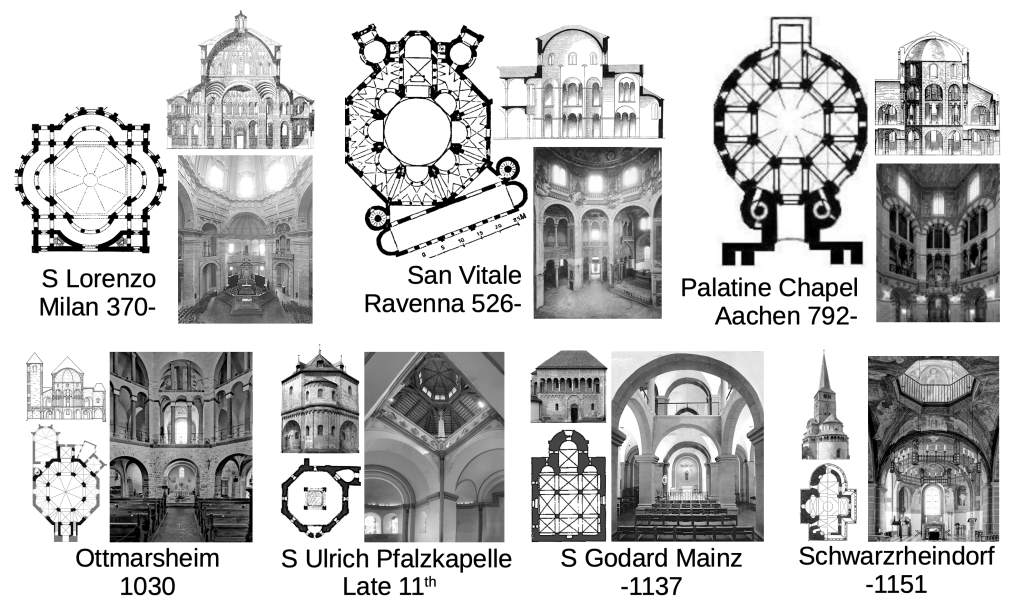
Imperial chapels were another important centrally planned style of church architecture. The 4th century church of S. Lorenzo in Milan may have originally been built as an imperial chapel. It is a remarkably innovative building, with a two-story ambulatory surrounding a three-story inner dome, which is built on an architecturally complex octagon with its own set of exedrae.
S. Vitale Ravenna (526-) repeats the two-story ambulatory and three-story inner dome of S. Lorenzo, but makes both the inner and outer walls octagonal, with a beautiful set of exedrae extending from each bay of the central colonnade. Charlemagne modeled his Palatine Chapel in Aachen (792-) after S. Vitale, albeit without the complex set of exedrae. He even stole marble columns from Ravenna to decorate it.4 This chapel was widely renowned in the Holy Roman Empire and spawned several copies, most notably at Ottmarsheim Abbey (1030).
In the late 11th and early 12th centuries, a number of two-story doppelkapellen were built in German speaking countries. These seem to have derived from the Palatine Chapel at Aachen in that they they all contain two-story ambulatories surrounding a lofty central atrium. Aside from these commonalities, doppelkapellen could vary widely in their floor plans. The royal chapel of S Ulrich Pfalzkapelle (late 11th) contains an outer octagon within an inner square, while the palace chapel at Schwarzrheindorf Castle (-1151) contains an inner octagon inscribed within a Greek Cross. S. Godard’s chapel at Mainz Cathedral contains an inner square inscribed within an outer square.
Holy Sepulcher Influence
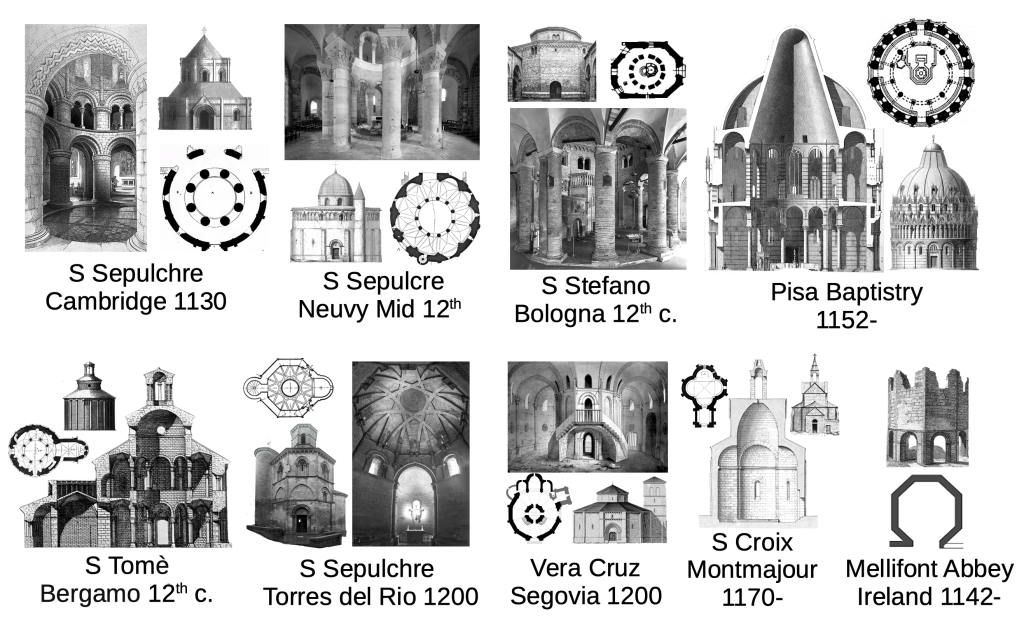
The 12th century crusades inspired a spate of copies of Jerusalem’s Holy Sepulcher (fig. 1). The best preserved of these is S. Sepulchre in Cambridge. The S. Stefano complex in Bologna consists of a whole series of buildings inspired by exemplars in Jerusalem including Holy Sepulcher. The Pisa Baptistry, although not a direct copy, seems to have also been inspired by the Holy Sepulcher, particularly its conical dome. There are also a number of centrally planned chapels from the period that may or may not have been inspired by Jerusalem, including the octagonal S. Sepulchre at Torres del Rio, notable for its Islamic-style vaulting, and the Chapel of Vera Cruz in Segovia, which seems to harken back to the Mausoleum of Maxentius (fig. 1).5
Other 12th century central plans include the chapel of S Crox in Montmajour Abbey which features a quatrefoil plan and Mellifont Abbey, which features an octagonal lavabo, an interesting architectural choice that may have been used to draw a connection between hand washing and baptism.
English Chapter Houses
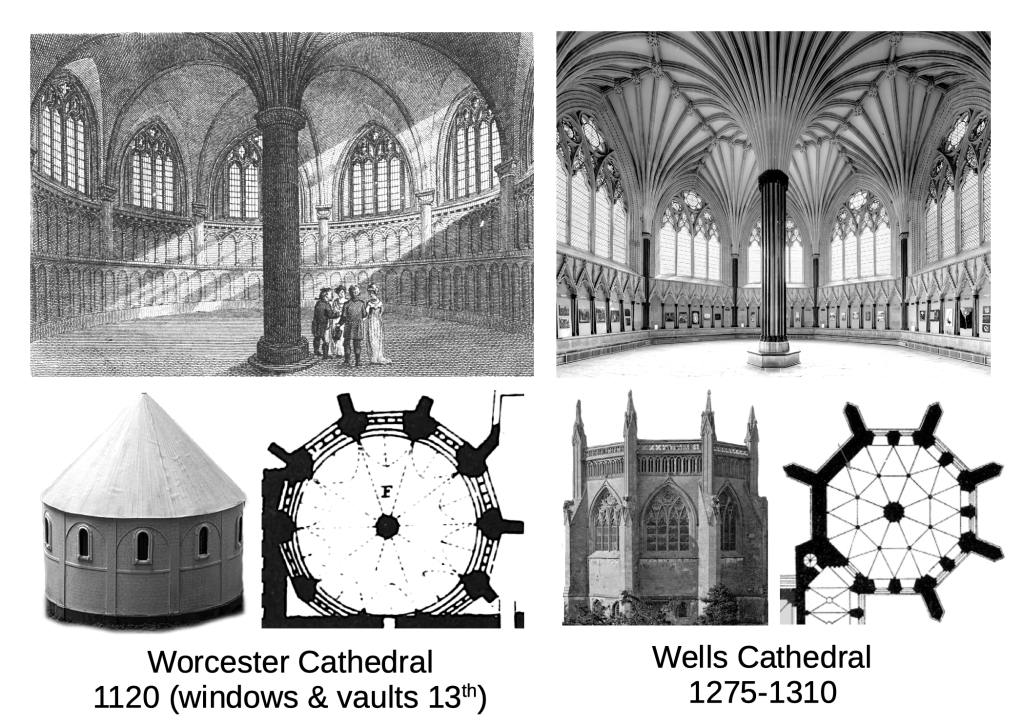
Chapter houses are large meeting rooms attached to monastery churches where monks read scriptures and hold meetings. Most medieval chapter houses were built on rectangular plans. However Worcester Cathedral’s 1120 chapter house set a precedent for circular and octagonal chapter houses in England. Worcester’s chapter house was modified in the 13th century to include large gothic windows and vaults but originally it was a simple conical structure as shown in the illustration above. Other English chapter houses became showcases for beautiful vault work like the famous “palm vault” in the Wells chapter house.
In Evolution of the Church Floor Plan Part III, we will discuss the evolution of floor plans from the Renaissance to the present day.
- Earlier mausoleums from Roman Republic and early Roman Empire were focused on exterior decoration. Later mausoleums transferred that emphasis to the interior. Diocletian’s mausoleum contains both an exterior and interior emphasis. Early Christians rejected the exterior emphasis to focus on the interior. See Mark Wilson Jones, Principles of Roman Architecture (New Haven, Yale University Press, 2003 pg. 74) ↩︎
- Our Lady Kalundborg may have been built with a centralized plan to show solidarity the recently fallen Jerusalem (1187), which contained many centralized cross in square plan churches. See Roger Stalley, Early Medieval Architecture (Oxford University Press, 1999 pg. 76_ ↩︎
- Byzantine architectural historian Nicolay Brunof believed that Little Hagia Sophia was modeled on S. George in Izra. There were cultic connections between Syria and Constantinople which could have encouraged architectural borrowing. The martyrs S. Sergius & S. Bacchus had a popular cult in Syria, notably at another cross-in-square martyrium for Sergius at Rusafa. According to legend, Emperor Justinian’s life had been spared due to a vision of the two saints, and Little Hagia Sophia was later dedicated to them. See also G. Kolpakova Искусство Византии. Ранний и средний периоды, (pg. 93) ↩︎
- Both S. Vitale and the Palatine Chapel in Aachen dedicated one of their octagonal bays as the chancel for the altar, making the structure functional as a place of worship. ↩︎
- See also the London Temple Church -1185, modeled on H. Sepulchre, but gothicized in the 19th century. ↩︎
 Evolution of Architecture
Leave a comment