A Brief Genealogy of Multi-Story Urban Architecture
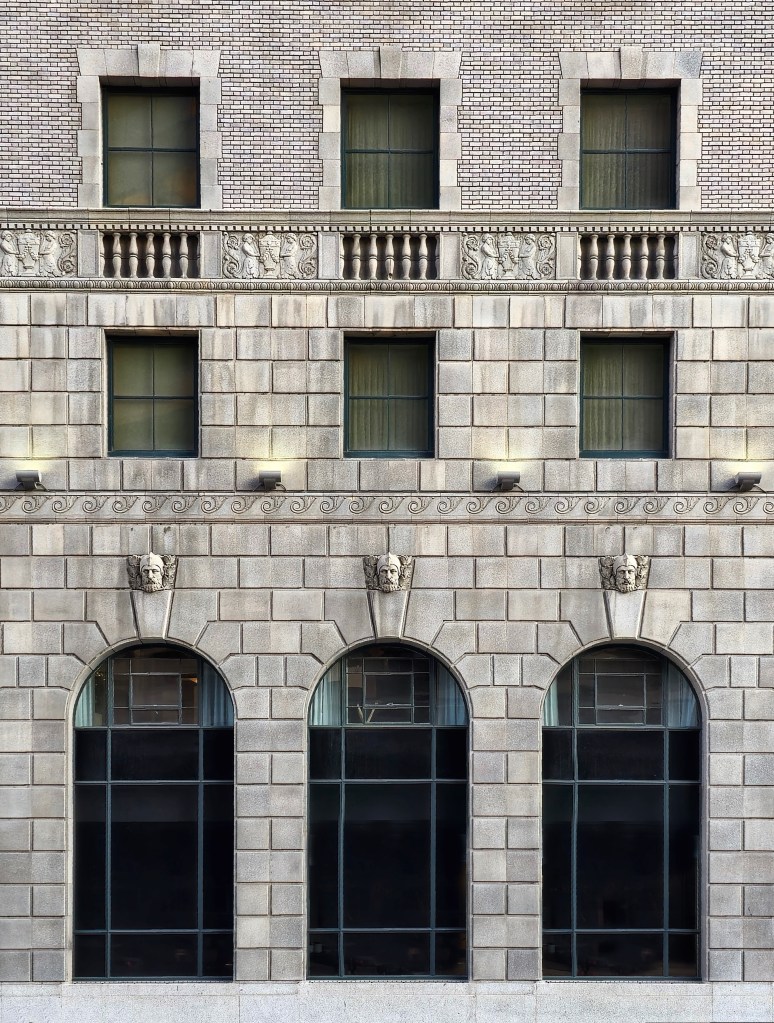
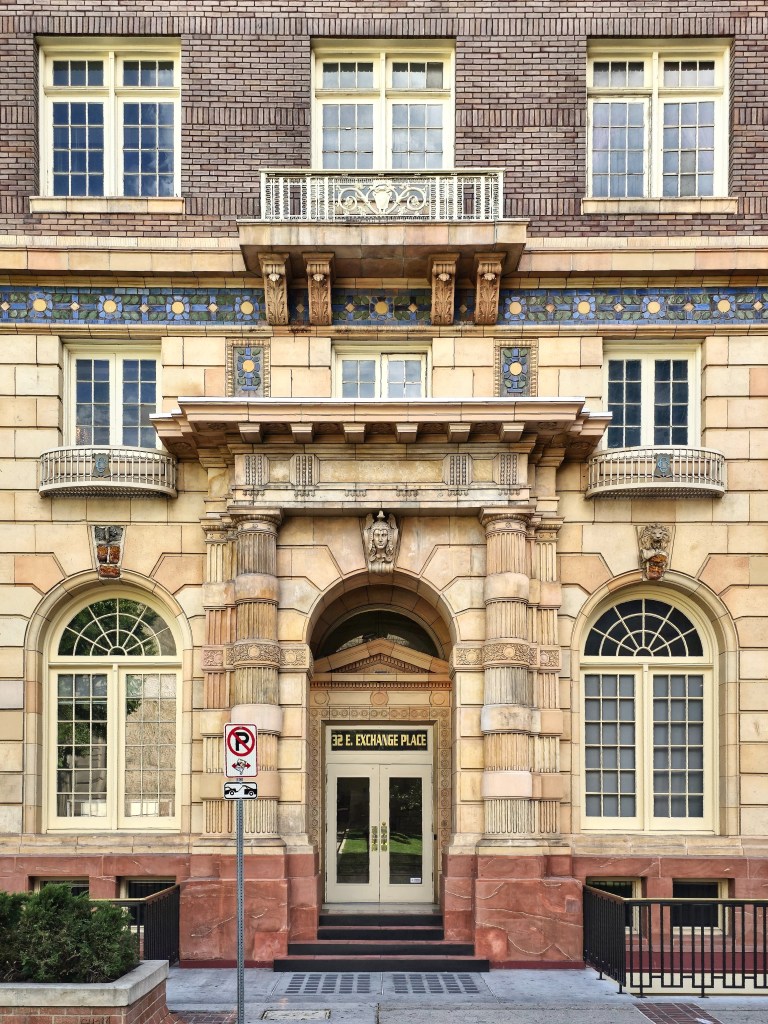
Downtowns from Beijing to Birmingham are dominated by classical multi-story buildings built in the late 19th and early 20th centuries. In my hometown of Salt Lake City there are hundreds of classicized buildings of various styles from the restrained classicism of the 1923 Hotel Monaco to the lavish ornamentation of the 1908 Commercial Club (shown below). This post will trace the evolution of classical multi-story architecture from its roots in ancient Rome into the modern period. I’ve called this genealogy “the Evolution of the Palazzo Style” to highlight the debt it owes to the Italian palazzo or palace.
Ancient Rome (1st c. BC to 4th c. AD)
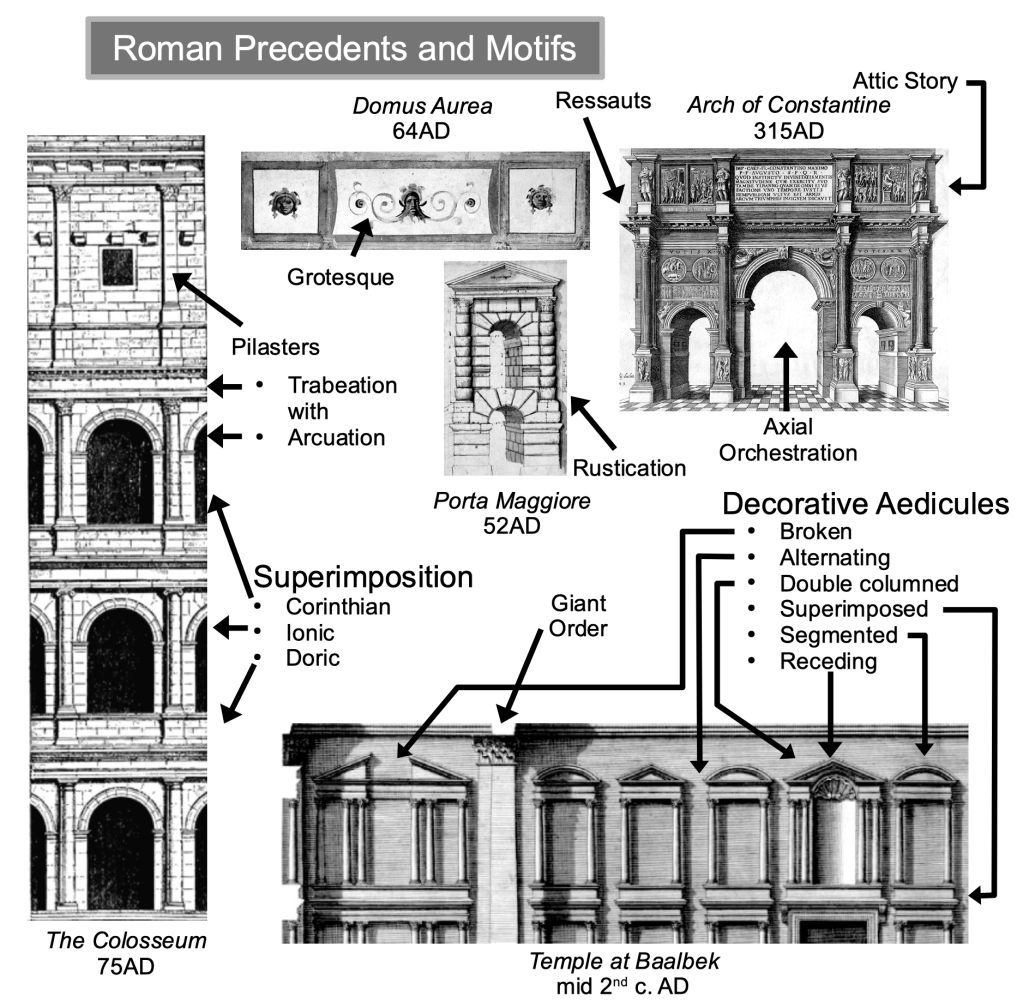
While the basics of classical architecture were developed in Ancient Greece, it was the Romans that formulated most of the motifs we associate with urban classical architecture today. These include the following:
- Combined arcuation (arches) with trabeation (post & beam) Colosseum
- Superimposition of column styles on multiple floors Colosseum
- Pilasters (rectangular columns attached to walls) Colosseum
- Rustication (textured stone types) Porta Maggiore
- Decorative aedicules (pedimented frames) featuring broken, alternating, double columned, segmented, and receding pediments Temple at Baalbek
- Giant columns (columns spanning two stories) Temple at Baalbek
- Ressauts (projected entablatures) Arch of Constantine
- Grotesques (decorated panels) Domus Aurea
- Axial Orchestration (symmetrical arrangements forming harmonious architectural compositions) Arch of Constantine
(The Temple at Baalbek features a particularly impressive range of Roman innovations. However, due to its location in the Ottoman Empire during the Renaissance, Baalbek could not have influenced Renaissance architecture. However, many of the innovations present at Baalbek can be found in other Roman structures known during the Renaissance. For example, Renaissance theorist Palladio illustrates a now-lost example of alternating pediment styles at the Temple of Jupiter (Palladio Book IV p. 43). Alternating pediments are also found at the Temple of Diana in Nimes, the Library of Celsus, and the Temple of Vespasian in Pompeii. Giant orders outside of Baalbek are rare, but Roman architectural theorist Vitruvius describes one at the lost Basilica at Fano. Broken pediments are also found at the tombs of Petra.)
Florentine Renaissance Palazzi (1444-1489)
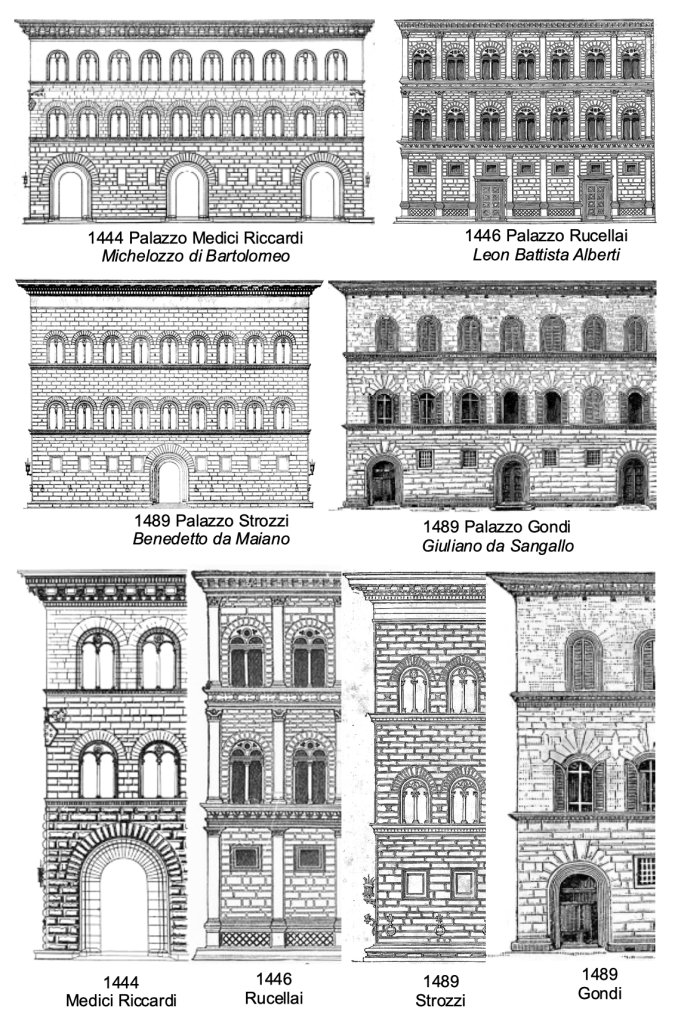
In Florence, 15th century Renaissance architects looked to ancient Rome for inspiration in designing their urban palazzi (triple-storied city blocks housing the nobility.) In the examples above, one can see the influence of ancient Rome in the arched windows, the pilasters at Rucellai, and the rich moldings. However, the Florentine architects also contributed the following innovations:
- The Palazzo Cornice. Atop each palazzo is an elaborate classical molding. In ancient Rome, moldings were only used as part of a codified arrangement of columns, architrave, frieze, and fascia. But Renaissance architects detached the upper moldings from the traditional arrangement and used them as decorative cornices for the building as a whole. This type of cornice is ubiquitous in downtowns around the world today.
- Rustication. Romans only occasionally used rustication, but during the Renaissance it became a standard form of mural articulation. The arrangements of large, rusticated voussoirs surrounding the doorframes at Palazzo Gondi and Riccardi were to become enormously influential.
- Astylar Window Arrangements. With the exception of the Palazzo Rucellai, the palazzi above feature astylar windows, meaning the windows are built directly into bare walls unadorned with columns. This austere style was revived by later architects seeking a sober alternative to ornate versions classical architecture encrusted with lots of decorative columns.
These early palazzi are still studied by architectural students today as harmonious models of geometry and order.
Roman Renaissance Palazzi (1489-1546)
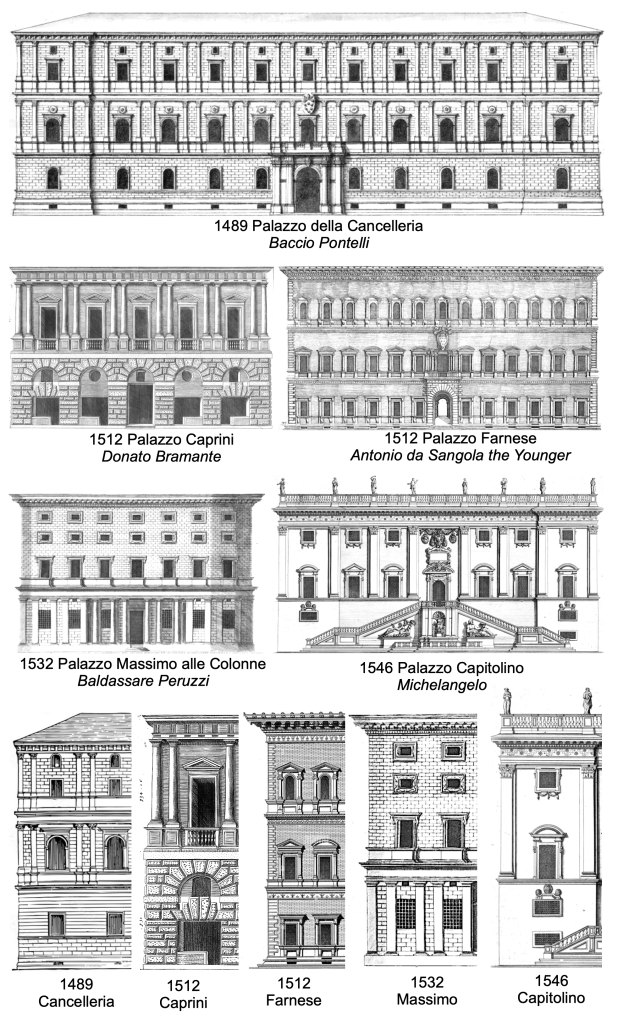
In the late 15th century, the Renaissance migrated from Florence to Rome. Here architects built on the rusticated, three-story Florentine model, but also looked to ancient Rome for further inspiration. Roman precedents such as paired columns (Cancelleria and Caprini), alternating segmented and pedimented aedicules (Farnese), and giant columns (Capitolino) begin to appear.
We also see a number of new Renaissance innovations including the fancy window frames in the upper stories at Massimo and Capitolino, the rusticated quoins articulating the sides at Farnese and Massimo, and the balustrade (balcony railing) crowning the Palazzo Capitolino. (Roman ruins sometimes had remnants of small molded columns and Renaissance architects erroneously thought these columns must have belonged to balustrades. However, balustrades are in fact a Renaissance invention and can be seen as early as 1480 at Giovanni Sangallo’s Villa di Poggio a Caiano near Florence. This villa also features rusticated quoins.)
Palazzo Massimo is also notable for its curved profile, which anticipates the Baroque period and its obsession with curvilinear construction.
Venetian Renaissance Palazzi (1500-1545)
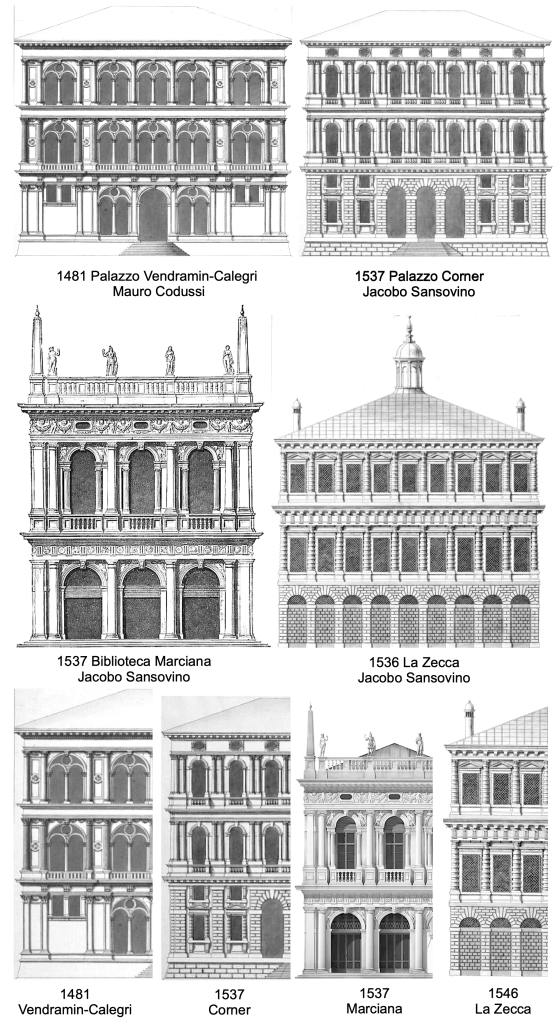
The Venetian Renaissance was notable for its fine ornamentation, spacious windows, and abundant use of columns. At Palazzo Vendramin-Calegri, the double arched windows first seen at the Florentine Palazzo Ruccellai reappear, but take up almost the entire floor and are set between delicately carved pairs of columns. Balustrades can be seen on the piano nobile (2nd floor) of Corner and Marciana (2nd floor). Biblioteca Marciana features an elaborate Doric order on its ground floor with swags and other decorative elements on the second floor frieze. La Zecca features heavily rusticated columns which blend dynamically with the rhythm of the triglyphs and modillions in the frieze above.
Palladian Palazzi (1542-1580)
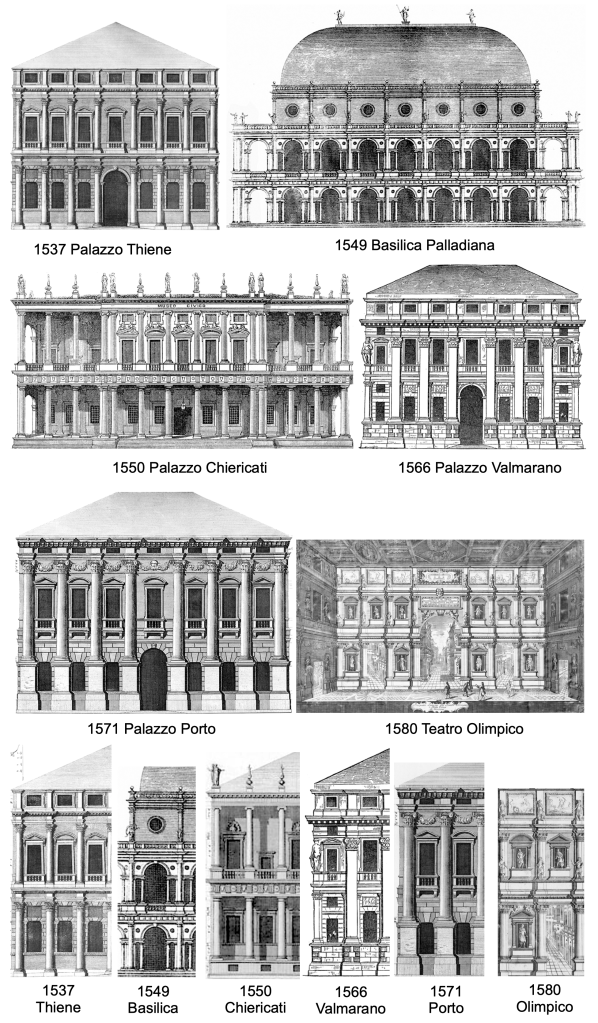
Antonio Palladio was perhaps the greatest of all Renaissance architects. Palladio built the palazzi shown above in his native town of Vincenza, which is very near Venice and shows a remarkable affinity with Venetian styles. Columnar construction has completely replaced the mural focus of earlier Florentine and Roman palazzi. However, Palladio has also taken Michelangelo’s giant columns from Palazzo Capitolino in Rome and adapted them for at Palazzo Valmarano and Palazzo Porto. Palladio’s careful study of Roman models also prompts him to introduce the “attic story” based on triumphal arches, seen at Palazzo Thiene, Valmarano, Porto, and Teatro Olympico.
Palladio’s work was highly influential and became a distinct architectural style called Palladianism. A frequent returning motif in classical revivals is the “Palladian window.” One can see this motif in the first and second floors of the Basilica Palladiana (shown above), which features a central arch framed by two smaller rectangular openings. Palladio took this motif from architect Sebastiano Serlio who illustrated it in his treatise on architecture and for this reason it is sometimes called the “serliana.”
Late Renaissance Mannerism (1525-1558)
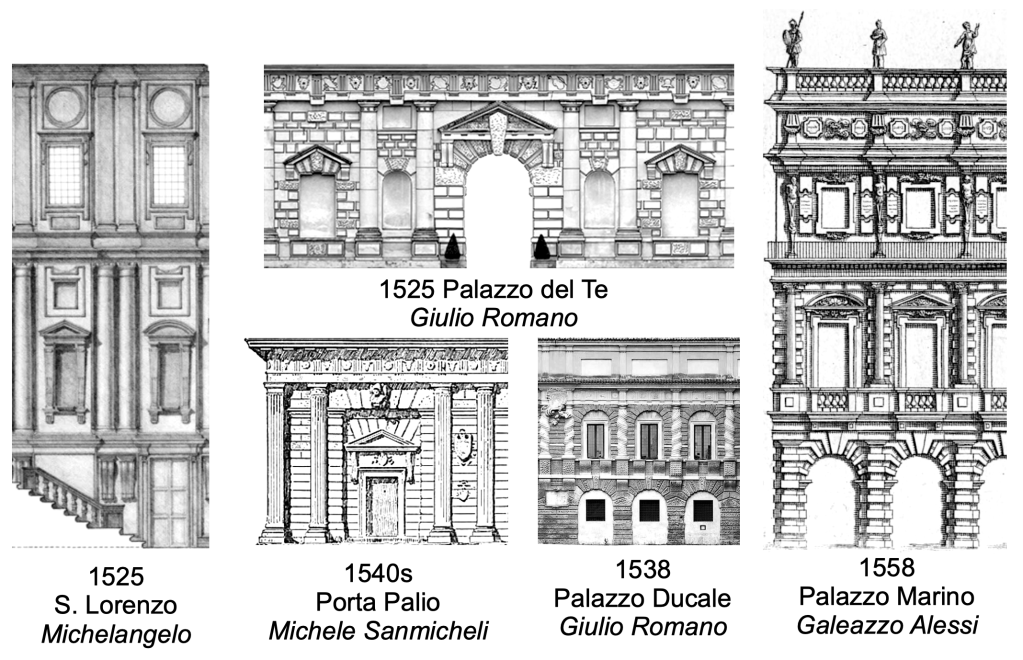
As the Venetian and Palladian Renaissance was unfolding in all its elegance, other areas of Italy were experimenting with a style called mannerism. Mannerism takes earlier forms of Renaissance rustication to expressionistic extremes. The Palazzo del Te in Mantua features rusticated keystones of enormous size as well as triglyphs which slip beyond the bounds of their architrave. Michelangelo’s Library of San Lorenzo features unusually large consoles and aedicules with strange, tapered columns. Palazzo Ducale in Mantua adds Solomonic columns and the Palazzo Marino in Milan contains a riot of extreme rustication and sculptural ornamentation.
Renaissance Revivals in the 19th and 20th centuries drew heavily on this mannerist form of Renaissance architecture.
French Renaissance
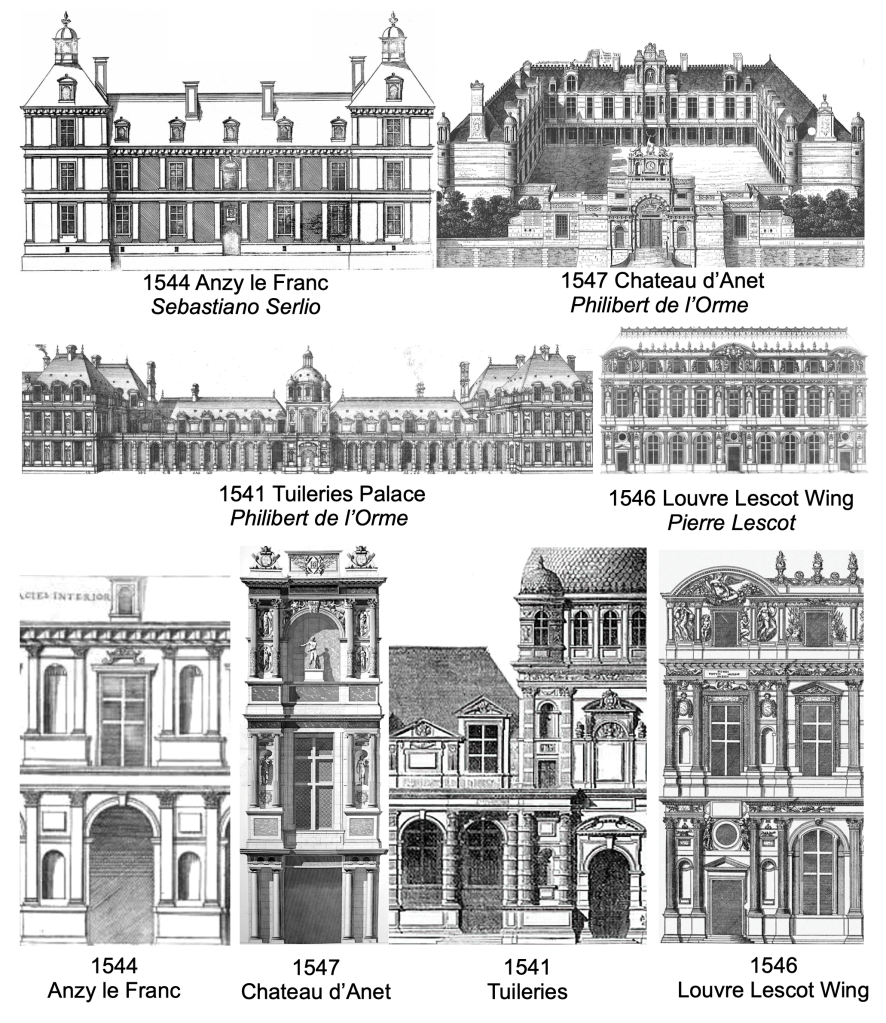
In the 16th century as the Protestant Reformation was unfolding, the Italian Renaissance went into decline. Sebastiano Serlio and other Italian architects left for France, spreading Italian Renaissance influence there.
Serlio’s Chateau Anzy le Franc features a double-stacked triumphal arch motif which was to become a major theme of French Renaissance architecture, as can be seen in each of the elevations above.
French Architect Philbert de l’Orme was highly influenced by Serlio’s work, particularly his mannerist rustication. He built on Serlio’s rusticated columns to create his own banded column that he called the “French order,” seen throughout the Tuileries Palace (and in the 1908 Salt Lake City Commercial Club example above.)
The most influential building of the French Renaissance is the Louvre’s Lescot Wing of 1546. Louvre Palace took many centuries to complete, and each time work recommenced, architects looked back to the Lescot Wing for inspiration. This gave the Louvre a remarkable stylistic consistency across the centuries and ensured that the style would be imported to other nations seeking to emulate the prestigious French artistic culture.
Elizabethan Renaissance (1550-1605)
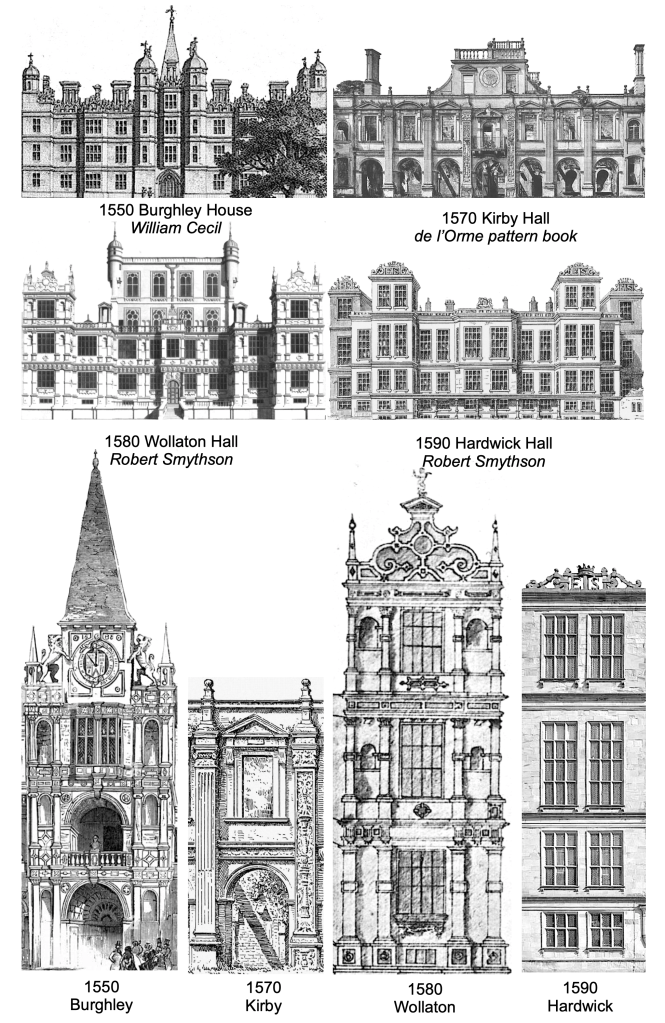
The English Renaissance, while not as central to the evolution of the Palazzo style as the French Renaissance, is still worth noting for its innovative use of large mullioned windows. This style grew out of a medieval English style called Perpendicular Gothic which featured enormous church windows held up by a geometric grid of mullions.
Continental Renaissance influence arrived in Britain via publications like Serlio’s On Architecture. At Burghley Hall, we see the influence of Serlio’s triumphal arch theme. Much of Kirby Hall’s architecture was taken from a treatise by Philibert de l’Orme and drawings of another French architected named de Cerceau. Wollaston Hall, in addition to featuring a Serlian set of stacked columns, contains an elegant strapwork derived from designs by Flemish architect Vrederman de Vries.
Jacobean Renaissance (1550-1619)
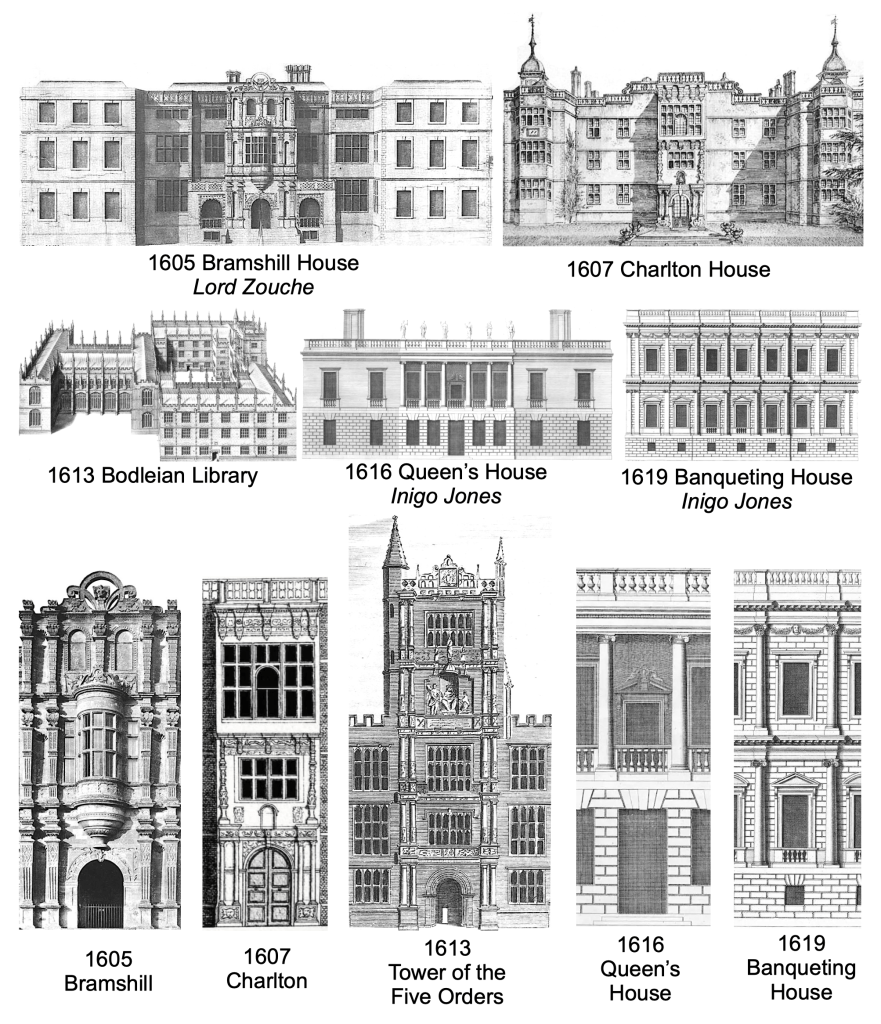
The Jacobean Renaissance was in many ways a continuation of the Elizabethan style. In the examples above, Bramshill and Charlton Hall and the Tower of the Five Orders contain paired sets of stacked columns familiar from Serlio’s treatise as well as large banks of mullioned windows. Bramshill also draws on Michelangelo with tapered columns first seen at the Library of San Lorenzo. The Tower of the Five Orders and Bramshill also feature crowning strapwork derived from Flemish models.
Inigo Jones was an outlier for the period. He drew upon the writings and works of Antonio Palladio to create harmonious, disciplined classical structures that were influential in the establishment of Palladianism a century later.
French Baroque (1620-1699)
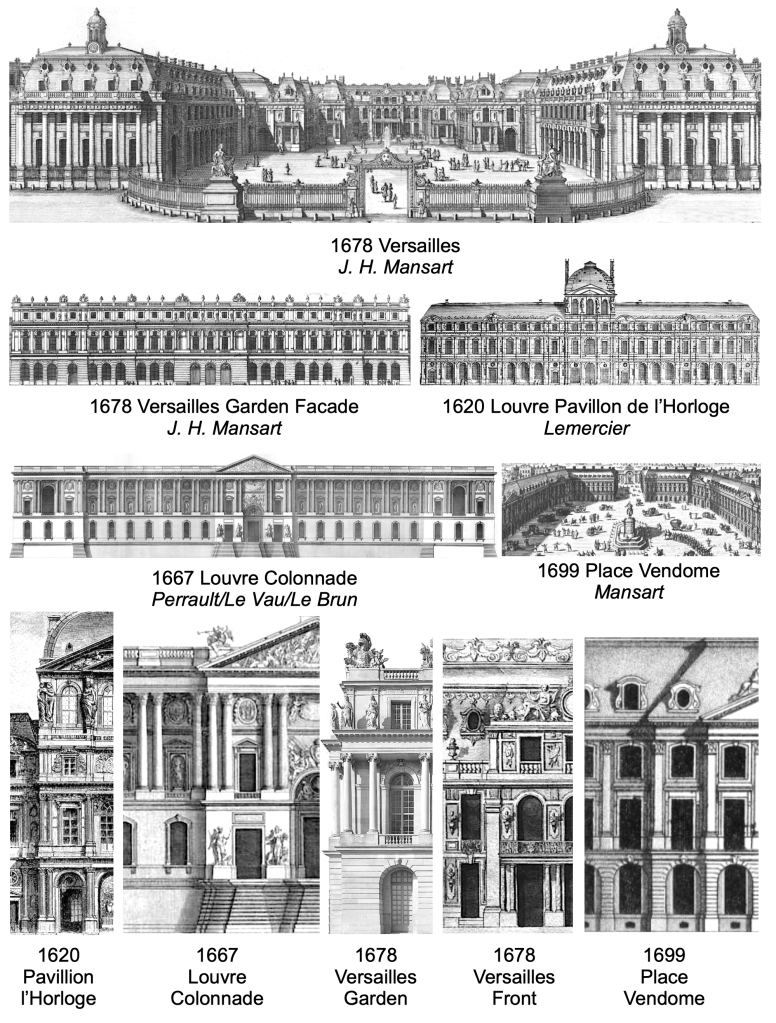
The Baroque period is usually associated expressionistic Italian styles of curved profiles and overlapping planes. In France and England however, the Baroque period was more restrained. The 1620 Pavilion de l’Horloge adheres more closely to the previous Renaissance pattern of mannered rustication and sets of stacked triumphal arch motifs. However, by the 1660s, these Serlian motifs have been abandoned for more streamlined, horizontally oriented colonnades.
Like Italian Baroque, French structures are encrusted with ornamentation. However, this ornamentation is meant to glorify an orderly structure symbolic of the powerful French State, while the ornamentation in Italian Baroque churches are meant to glorify the more expressionistic structures symbolic of the mysteries of the divine.
English Baroque (1664-1705)
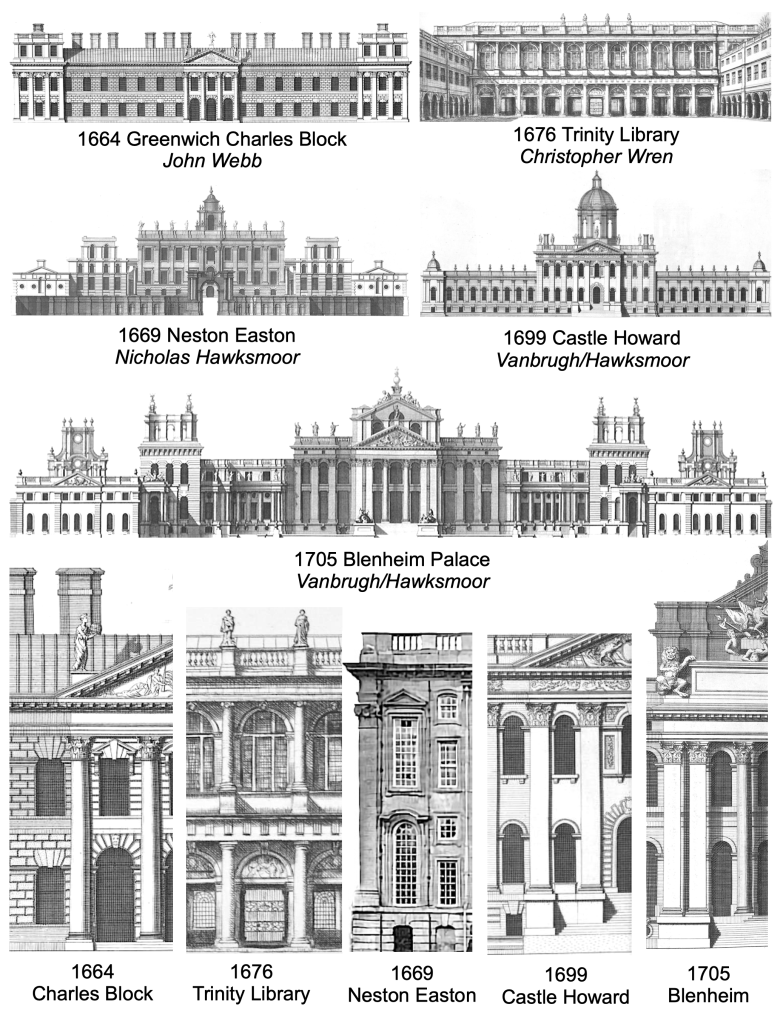
Like French Baroque, English Baroque is orderly and restrained compared to Italian Baroque. Excess ornamentation is eschewed as too “Catholic.” Christopher Wren’s Trinity Library draws heavily on Sansovino’s Bibliotecca Marciana from the Venetian Renaissance. The influence of Palladio can also be seen in the popularity of the pedimented temple fronts at Charles Block, Castle Howard and Blenheim Palace. The work of Vanbrugh and Hawksmoor, as close as they may have adhered to Palladian principles was still too “self-indulgent, creating a severe English Palladian backlash to Baroque architecture in the 18th century. This Baroque “disorderliness” can be seen in the elevation at Neston Easton, with multiple, off-set window styles.
German Baroque (1601-1720)
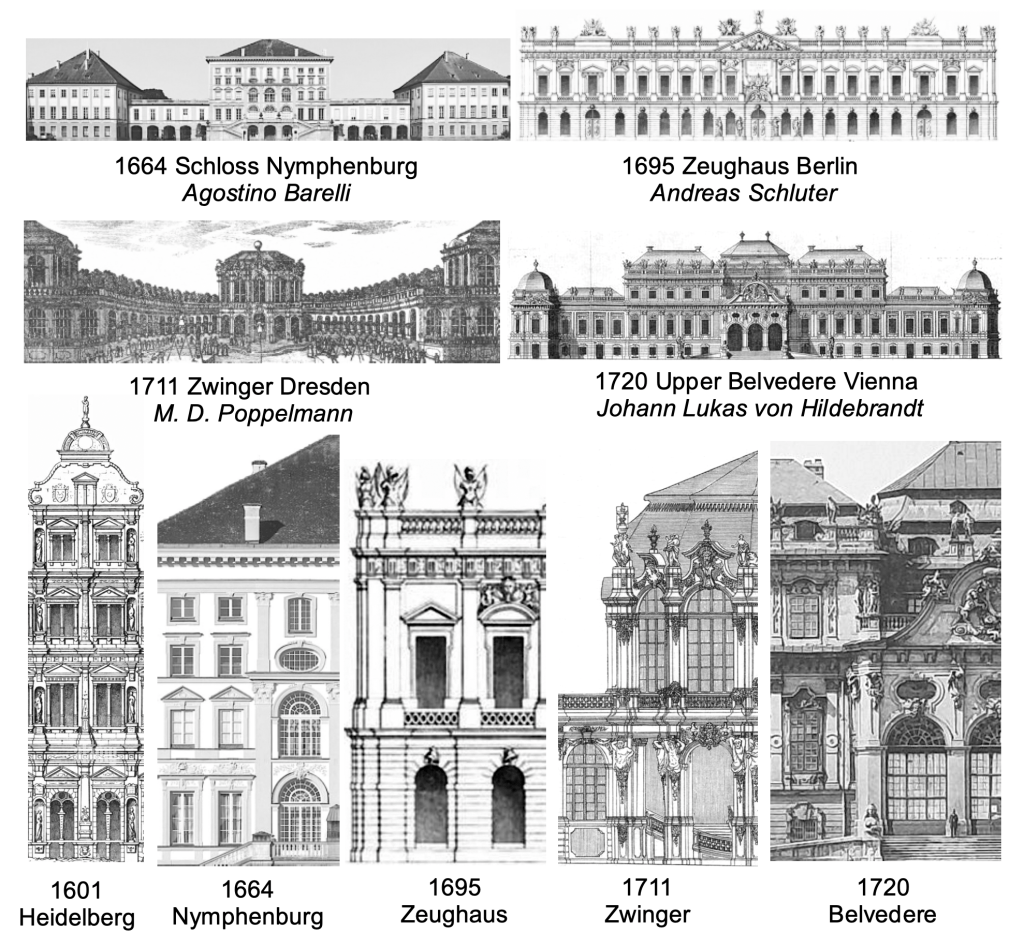
German Baroque architecture was influenced by Italian, French, and Dutch sources. The elevation shown at Heidelberg Castle shows the influence of the Dutch strapwork that also influenced the Elizabethan architecture highlighted earlier in this post, as well as the French influence of Lescaut and de l’Orme. Nymphenburg Palace, designed by an Italian architect Agostino Barelli features banks of astylar windows first seen in Florentine Palazzi. This austere, mural style remained popular in Italian country villas into the Baroque period. Zeughaus closely resembles the Palace of Versailles, albeit with a more restrained ornamentation and is representative of many French-style 17th and 18th century German palaces.
By the early 18th century, expressionistic forms of Italian church baroque began to influence palace architecture in German speaking domains, most notably at Zwinger and Belvedere Palace, both masterpieces of the Italian Baroque style.
British Palladianism (1715-1759)
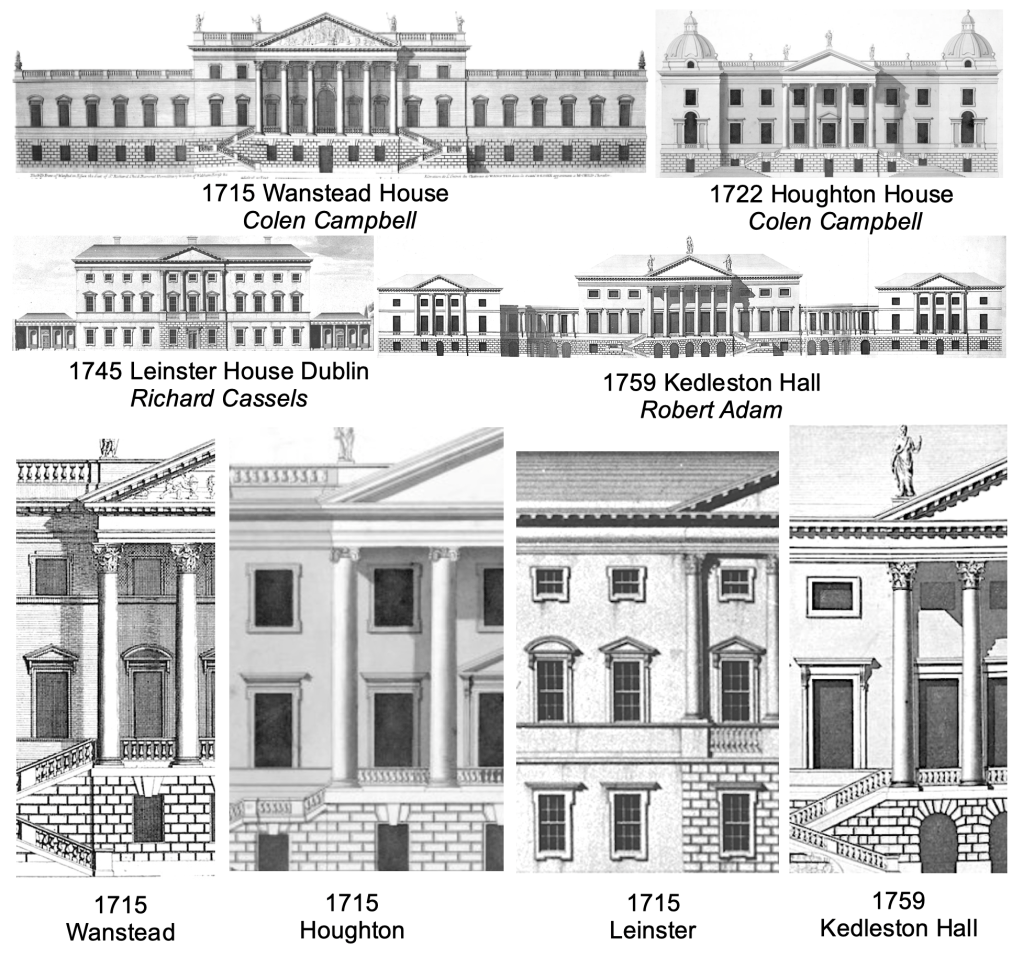
In early 18th Century England, a prominent group of architects and aristocrats began championing a severe, disciplined form of architecture influenced by Renaissance architect Antonio Palladio. The examples above highlight just how conformist this trend was, quite unlike Palladio’s inventive output.
Nevertheless, this style became very popular and was later transplanted to the United States. Leinster House became the model for Irish architect James Hoban design for the White House.
British Neoclassicism (1754-1794)
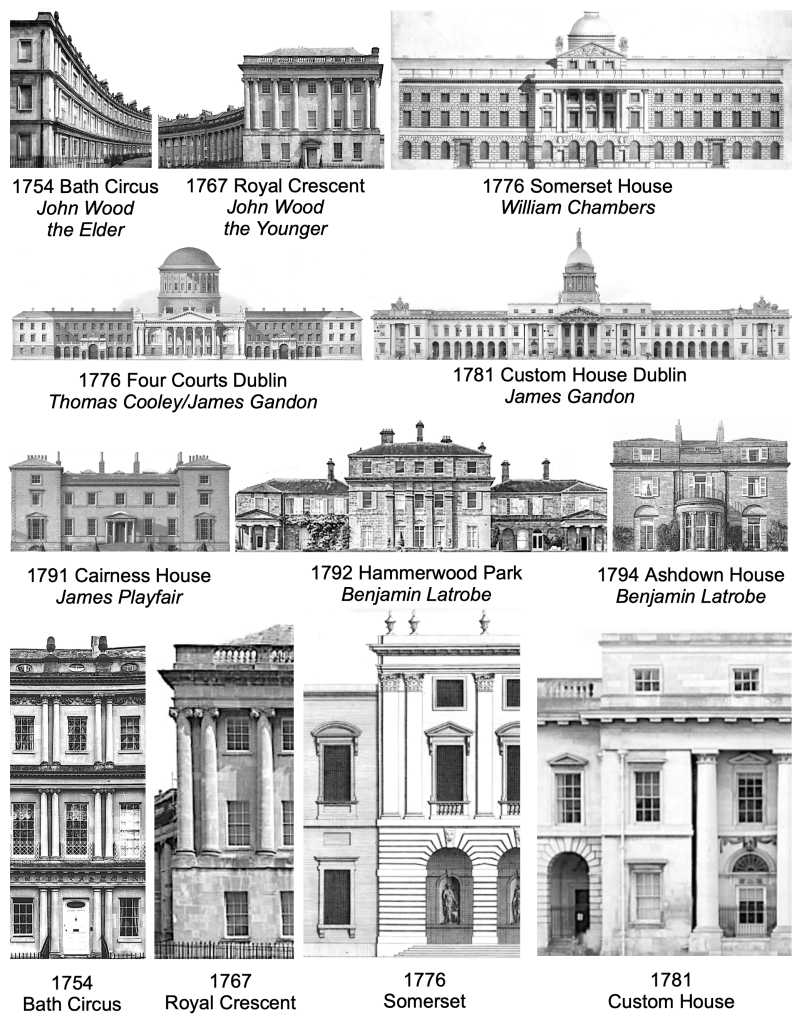
As the 18th century progressed, British architects kept the disciplined approach that characterized Palladianism but began to look beyond Palladio for inspiration in antiquity. Somerset House, Four Courts, and the Custom House shown above, owe a clear debt to Palladio, while the later 1790s houses Cairness, Hammerwood, and Ashdown break Palladian conventions while still retaining a harmonious sense of proportion.
In looking for inspiration in antiquity, some architects looked beyond Greece and Rome. Bath Circus was built in the round, with proportions taken from Stonehenge, while Cairns house contains masonic and Druidic motifs.
American Palladianism (1735-1765)
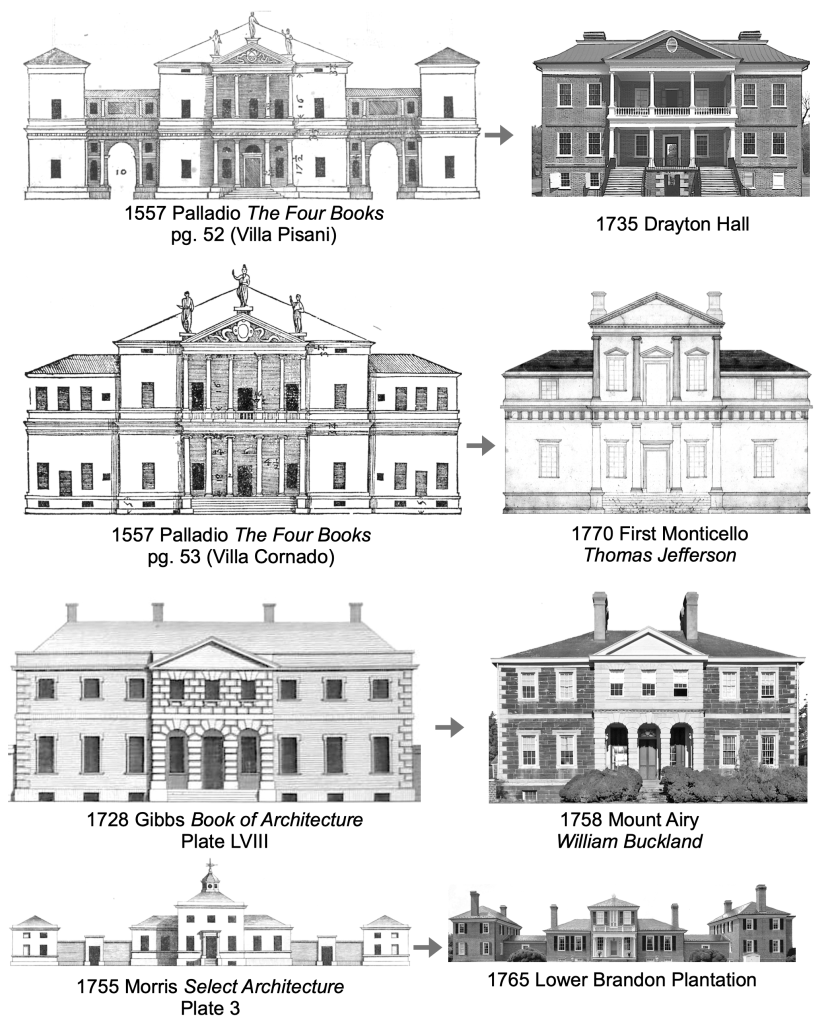
The illustration above demonstrates the debt early Colonial architects owed to Palladian architectural manuals. In some ways, Virginia plantations were a more natural fit for Palladian style villas like the one illustrated by Palladio above, as colonnaded loggias made more sense in warmer climates than they did in rainy Britain.
American Neoclassicism (1790-1854)
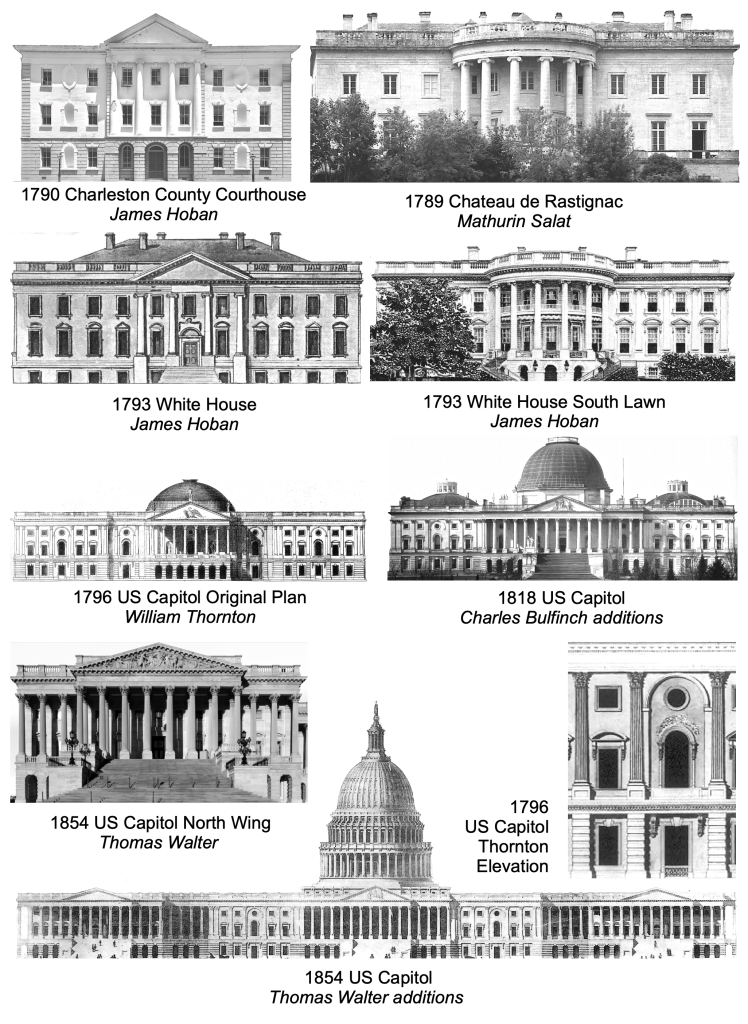
Neoclassicism was to become the official style of the new American Republic, defining state buildings throughout the country throughout the 19th and 20th centuries. The origins of this style are found in the Palladianism of Irish architect James Hoban, whose Charleston County Courthouse echoes the 1745 Leinster House Dublin (noted in the section on British Palladianism). Hoban designed the US White House on the same principles, including a rounded portico that was perhaps influenced by the 1789 Chateau de Rastignac, a drawing of which was said to have been seen by Thomas Jefferson during his French sojourn. However, a rounded portico is also seen in Benjamin Latrobe’s 1794 Ashdown House and was a popular neoclassical motif.
William Thornton’s US Capitol includes a hemispheric dome, Palladian motif from his 1567 Villa Rotonda. However, the elevations of the Capitol seem to depart from Palladianism in his inventive composition of an arch topped by an oculus bounded within a larger arch. This arrangement has precedents in the Louvre colonnade of 1667 highlighted in the section on French Baroque.
Charles Bulfinch expanded the dome and frontal colonnade of the Capitol in 1818 but kept the neoclassical architectural style. However times had changed by the time Thomas Walter took over as Capitol architect in 1850. He proposed an enormous Baroque dome patterned after Christopher Wren’s 1670 Cathedral of St. Paul in London. Additionally, Walter added wings that looked like imposing Roman Temples, a style had been popular in post-Napoleonic Europe.
The US Capitol became the architectural template for dozens of state capitols and city halls, giving a lot of civic architecture in America a neoclassical or Roman Imperial flavor.
French Neoclassicism to Beaux Arts
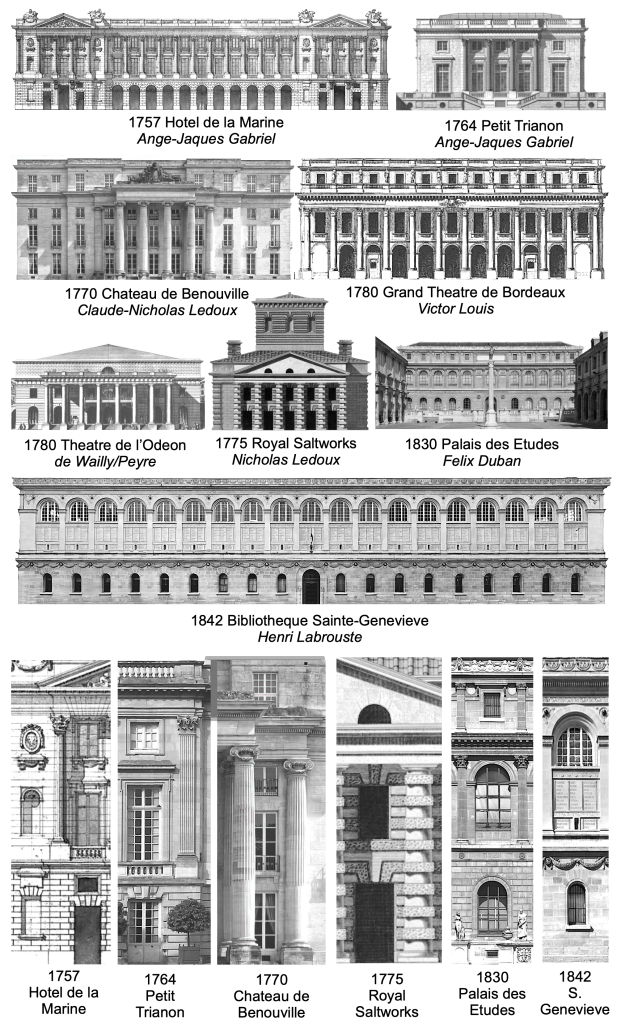
French neoclassicism is sometimes said to have begun with Perrault’s 1667 Louvre Colonnade illustrated in the French Baroque section. The colonnade had such an enduring influence that the 1757 Hotel de la Marine was built in a very similar style. As in Britain, French neoclassicism features symmetrical collonnaded porticos, but unlike Britain, they are less likely to be pedimented.
Ledoux’s 1775 Royal Saltworks highlights a dimension of neoclassicism that was more Romantic and expressive, influenced by the moody drawings of Italian artist Piranesi. Here rusticated columns are reintroduced, albeit in a more geometrically regularized form.
By early 1800s, France was building Roman temples and triumphal arches in honor of the new Napoleonic age, which provoked a backlash from the architects Felix Duban and Henri Labrouste, who focused on arched construction over columnar construction, which they saw as more structurally authentic. The Bibliotheque Sainte-Genevieve was revolutionary in its use of iron-frame construction and had a profound influence on later 19th century architecture. Labrouste’s influence at the Academy of Beaux-Arts took French architecture in exciting new directions and its influence soon spread around the world.
German Neoclassicism
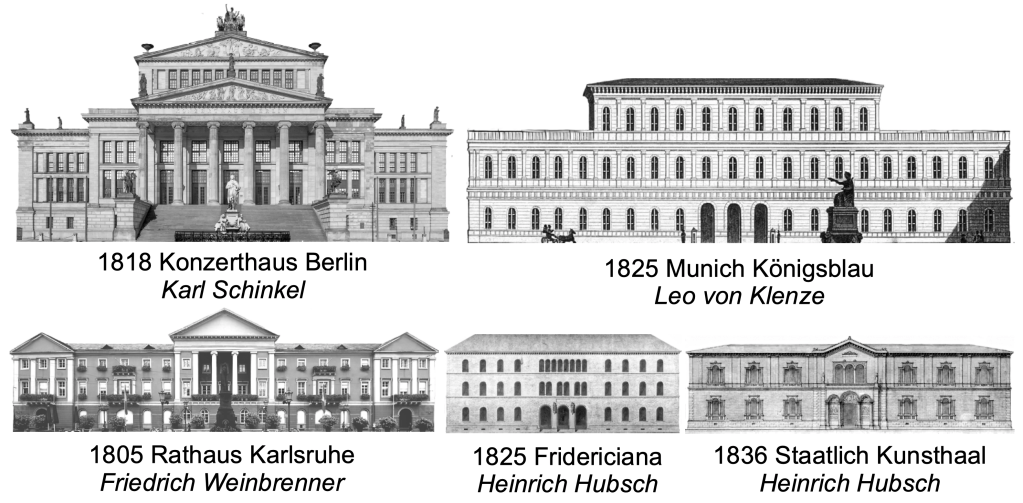
The three great neoclassical architects of Germany were Karl Schinkel in Prussia, Leo von Klenze in Bavaria, and Friedrich Weinbrenner in Karlsruhe. As in France there was a backlash against neoclassical obsession with columnar construction and antique imitation. Heinrich Hubsch led the crusade against the column, which he called the “architectural lie,” arguing that arches were more structurally honest, as can be seen in his 1825 Fridericiana. By the time the 1836 Staatlich Kunsthaal was built, Hubsch appears to have made peace with the column, which he uses as a form of articulation on his facade.
Italianate (1819-1851)
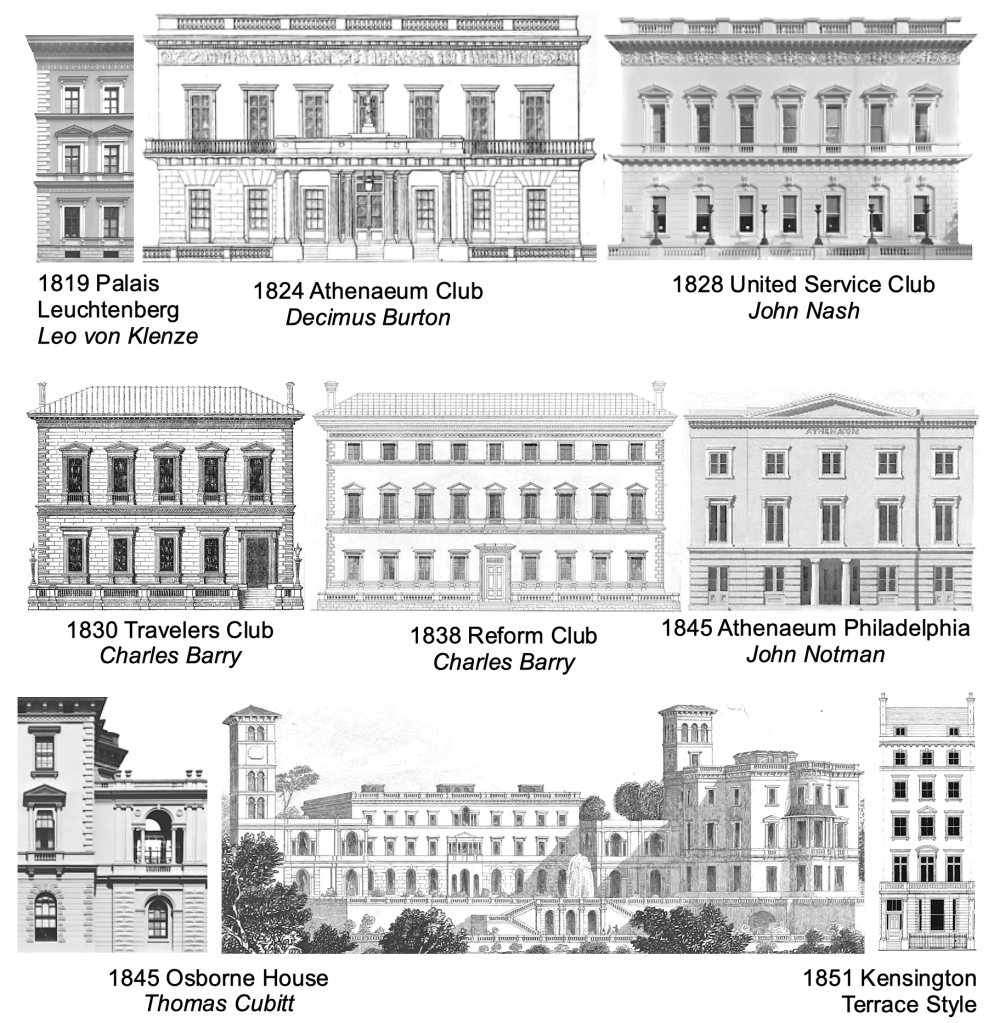
Charles Barry is usually credited with reviving an Italianate style in 1830 based on Renaissance Florentine palazzi featuring astylar window treatments and elaborate cornices. However, as early 1819, Leo von Klenze had built Palais Leuchtenberg in a specifically Florentine style. Decimus Burton and John Nash built gentlemen’s clubs in London in the 1820s in an astylar style, although they are generally described as “neoclassical” rather than Italianate. With Charles Barry’s Reform Club of 1838 we get a clear copy of the Roman Palazzo Farnese and this set the standard for the new revival. By 1845, the style had migrated to America where it was used in the Athenaeum Club in Philadelphia.
In 1845, Thomas Cubitt built a palace for Queen Victoria called Osborne House in the new Italianate style, which gave it a royal sanction and soon the style was popular all over London, including the Kensington Terrace example shown above.
2nd Empire (1851-1877)
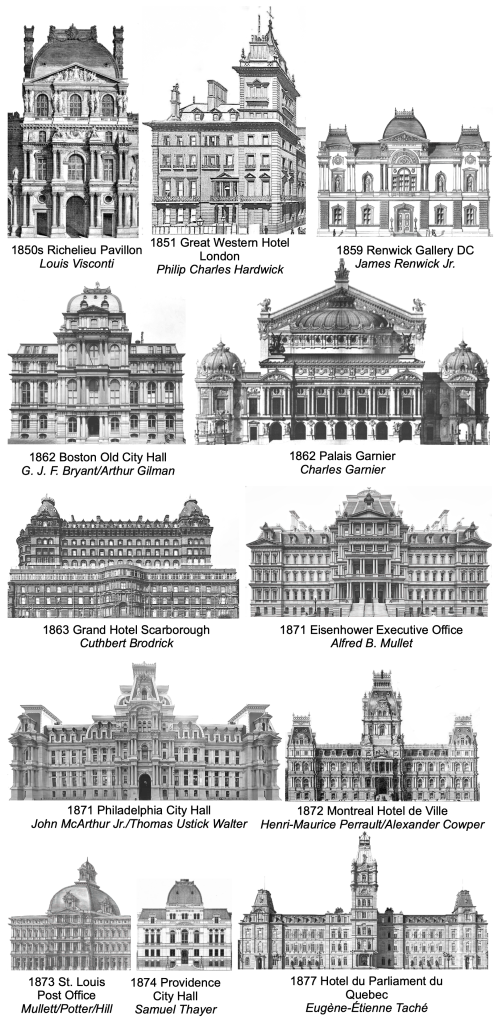
When Napoleon III ascended the French imperial throne in 1852, work recommenced at the Louvre Palace. Architect Louis Visconti built the new Richelieu Pavilion and other additions in the same style as Lemercie’s 1620 Pavillion de l’Orloge, which in turn had been influenced by the 1546 Lescaut Wing (shown in the sections on French Renaissance and French Baroque). This architectural continuity with the French Renaissance reinforced the broader stylistic drift away from neoclassicism towards a Renaissance Revival.
Such was the prestige of Parisian architecture, that interest in the French Renaissance soon spread around the world, where it was called the “Second Empire” style. It is generally characterized by imperial grandeur, mansard roofs, and stacked sets of paired columns.
Renaissance Revival (1854-1885)
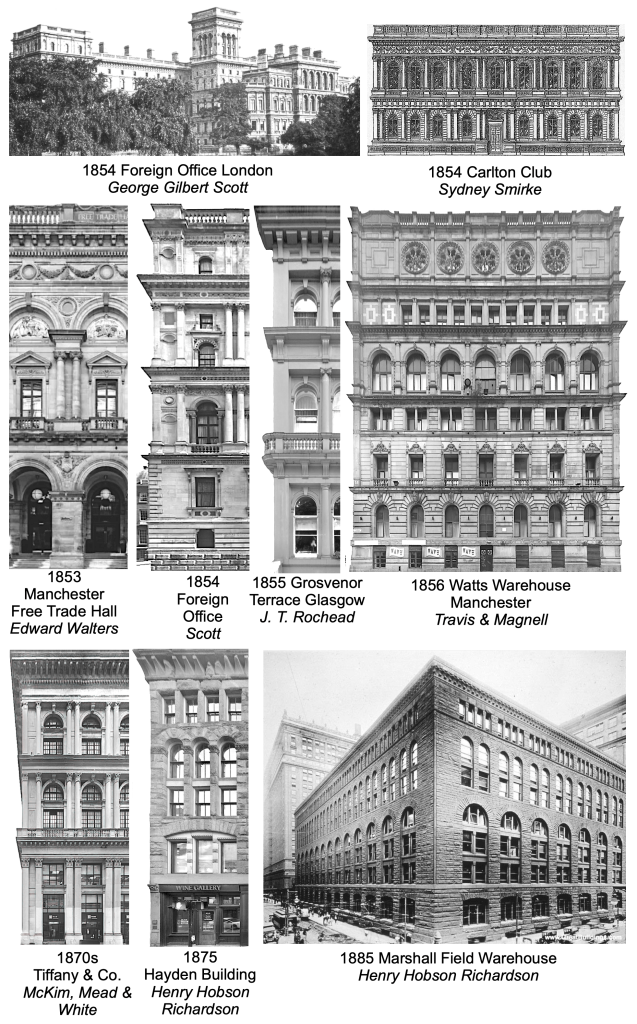
The emerging Renaissance Revival also looked back to the Italian and Venetian Renaissance. George Gilbert Scott’s 1854 Foreign Office complex builds upon the example of the Italianate 1845 Osbourne House, but without the astylar settings, opting for the paired column articulations popular in Second Empire style.
The 1854 Carlton Club recreates the Venetian Biblioteca Marciana (unfortunately lost in WWII). The Manchester Free Trade Hall also looks back to the richly decorated late Renaissance style seen in at Palazzo Marino in Milan and Grosvenor Terrace in Glasgow draws on the Venetian Palazzo Corner. The elevation of the 1865 Watts Warehouse piles up the Renaissance motifs in a composition seven stories high.
By the 1970s, the Renaissance Revival had reached the United States, as seen in the debt Tiffany and Co. building owes to the Venetian Palazzo Corner. At the same time, architect Henry Hobson Richardson introduced a highly rusticated Romanesque alternative to the multi-story arched construction of the Renaissance Revival. Richardson’s Hayden Building in Boston is the only surviving example in this palazzo style. However, so profound was his influence that thousands of downtowns were soon built in “Richardsonian Romanesque.” Richardson’s Marshall Field Warehouse of 1885 was unfortunately torn down, but not before it had exerted a strong influenced on the emerging modernist movement in the early 20th century.
Neo Renaissance (1860-1913)
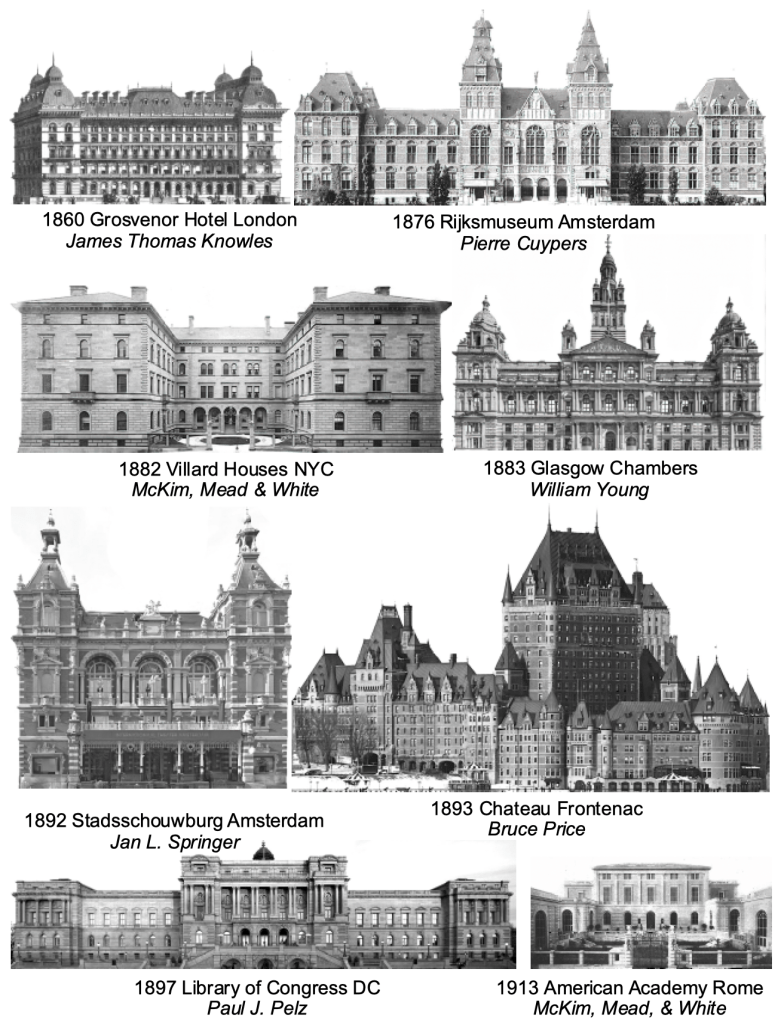
As we progress through the 19th century, stylistic trends become more eclectic and classification becomes more difficult. Some of the buildings shown above have been classified as Baroque, or Renaissance Revival, or even Beaux Arts style. My account is based on categories suggested in Architecture and Interior Design from the 19th Century: An Integrated History by Harwood, May and Sherman. These authors distinguish between the earlier Renaissance Revival and the later Neo-Renaissance, which was marked by a more careful academic study of various Renaissance styles. For example the Hotel Villard is closely modeled on Palazzo della Cancelleria in Rome. Chateau Frontenac is built in a Chateauesque style modeled on Chateaux from the Early French Renaissance.
It might be more useful to think of the period in terms of “early Renaissance Revival” which features mostly palazzo elevations taken from Venetian and Italian mannerist examples, and “later Renaissance Revival” which draws from a broader array of past influences.
Baroque Revival (1885-1904)
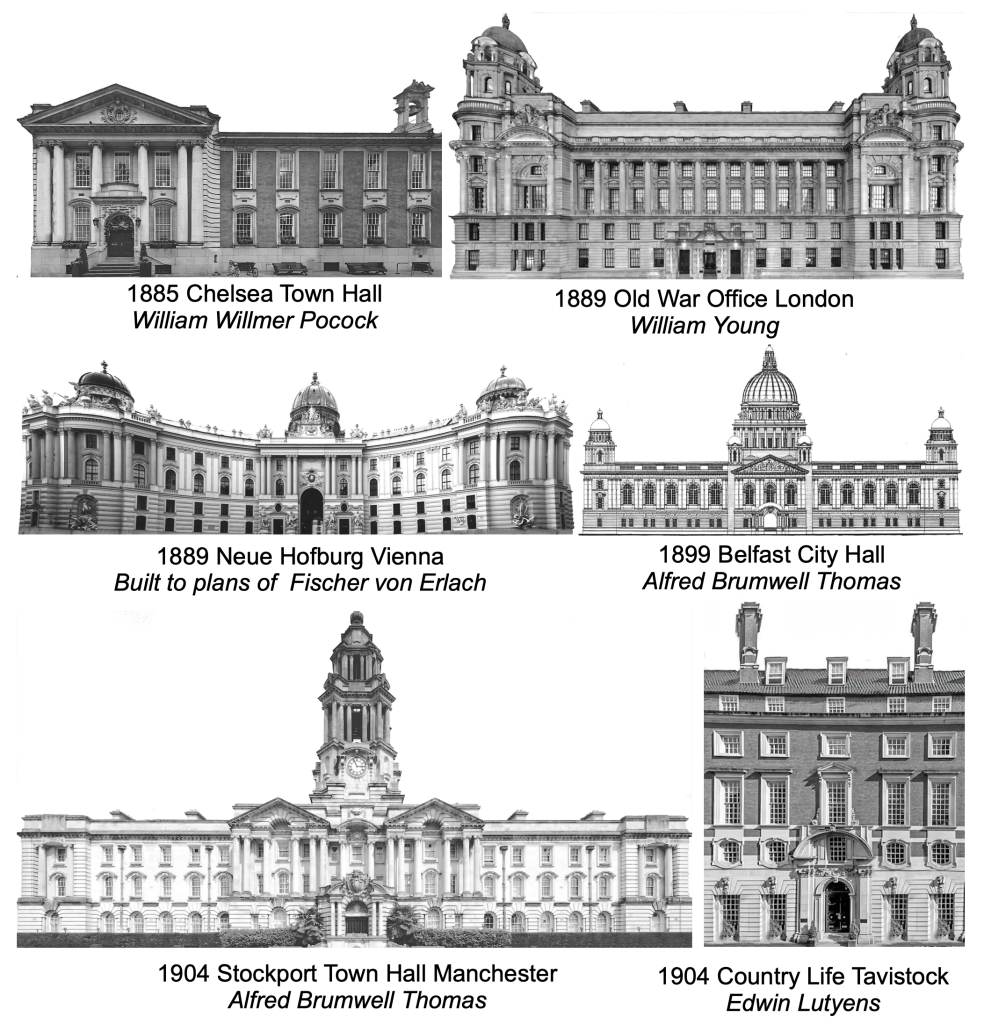
Later in the 19th and early 20th century, architects began looking to back to the Baroque period, especially the work of Christopher Wren, whose influence can be seen in most of the works shown above. For this reason, the Baroque Revival in Great Britain is sometimes dubbed “The Wrenaissance.” Chelsea Town Hall and Country Life Tavistock both take their inspirations from the brick and marble elevations at Wren’s Hampton Court Palace. The Old War Office, Belfast City Hall, and Stockport Town Hall were all influenced by the pavilions of Wren’s St. Paul Cathedral. Because much of the British Baroque Revival overlapped with the reign of Edward VII, this style is sometimes called Edwardian.
The Neue Hofburg in Vienna is also a Baroque Revival work, built to an uncompleted plan by German Baroque architect Fischer von Erlach.
Beaux Arts
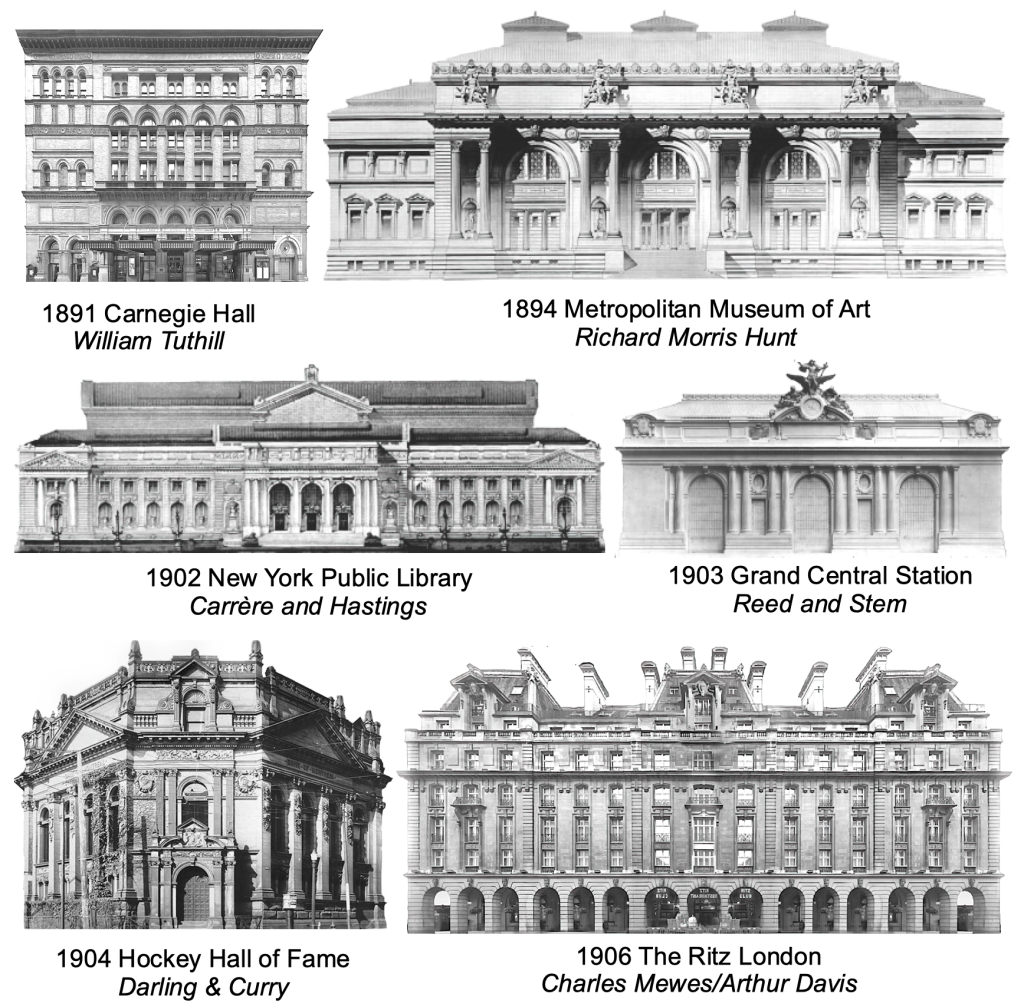
Beaux Arts style is another slippery category with examples sometimes overlapping with Second Empire, Renaissance, Baroque, and Neoclassical Revival styles. A building can be “Beaux Arts” if it was built by an architect trained at the Academy of Beaux Arts in Paris, as in the example of Richard Morris Hunt who built the Metropolitan Museum of Art. In the case of Carnegie Hall, it was built by William Tuthill, who didn’t study at the Academy, but did study under Richard Morris Hunt.
There are also stylistic characteristics shared by most of the examples above: symmetrical orientation, rusticated ground floor, and advancing and receding planes. The Met Museum, the New York Public Library, Grand Central Station, and the Ritz also have a central triple arch theme, sometimes characterized as a “five-part facade,” meaning that each of the three main arches, along with the two flanking sections make up a five-part composition.
Neoclassical Revival
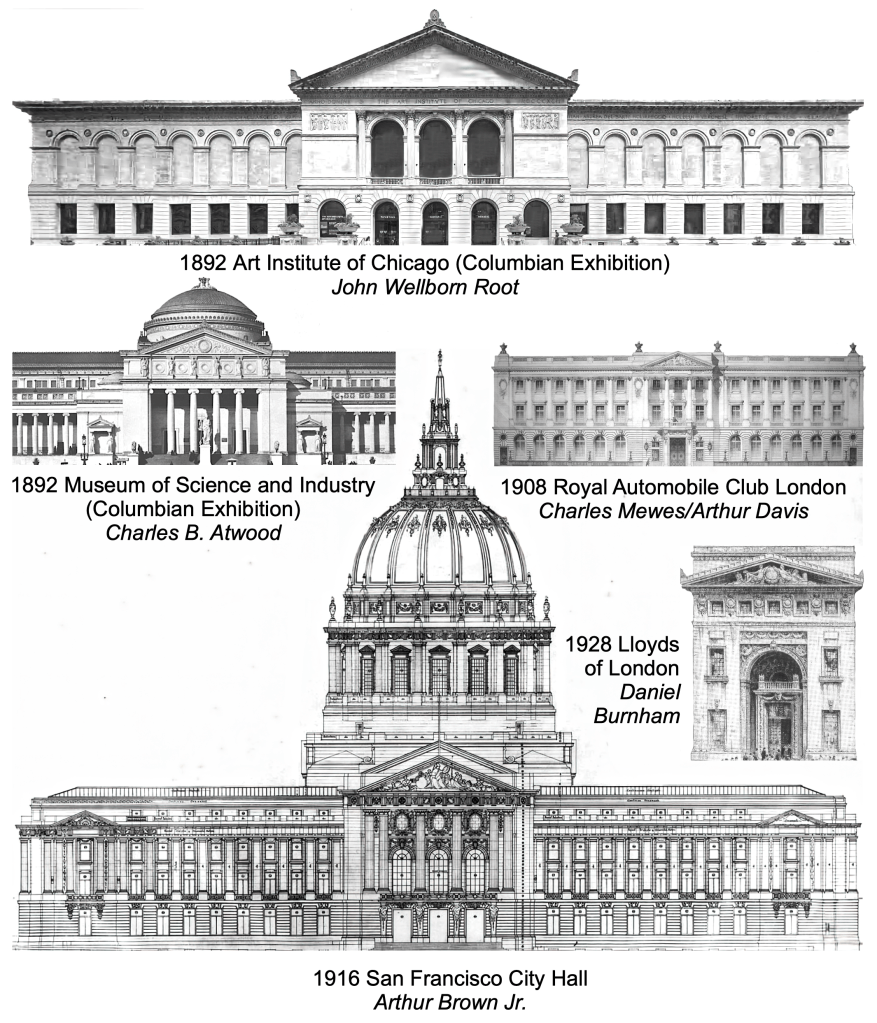
The Neoclassical Revival is usually said to have been inaugurated by the 1892 Columbian Exhibition in Chicago, where a magnificent temporary city was built on neoclassical principles. Two buildings remain from the exhibition, the Art Institute of Chicago, and the Museum of Science and Industry. The Museum of Science and Industry features a hemispheric dome and neoclassical portico reminiscent of the initial design of the US Capitol. The Art Institute of Chicago owes a clear debt to the Beaux Arts tradition, particularly Labrouste’s Library of Sainte-Genevieve highlighted in the section on French Neoclassicism.
The 1908 Royal Automobile Club marks a clear return to Palladian-influenced 18th century British neoclassicism, while the 1928 Lloyds of London revisits the 18th century’s obsession with allusions to antiquity.
The 1916 San Francisco City Hall is a typical example of the neoclassical revival in American civic architecture in the early 20th century, clearly in the mould of the US Capitol.
Modernist Classicism
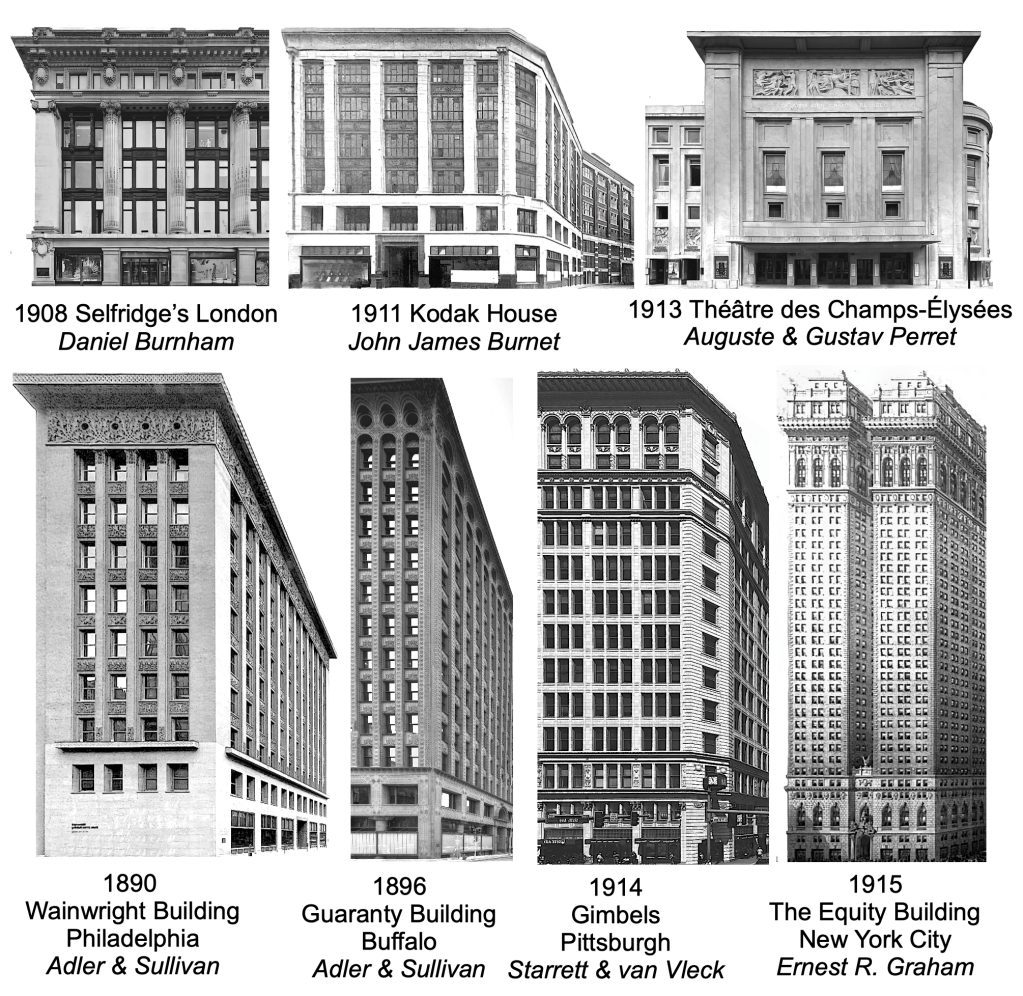
The return to neoclassicism coincided with a more streamlined and mechanized aesthetic emerging in the early 20th century. Classical architects began to eliminate excess ornamentation. Selfridge’s and the Kodak House contain modern steel and glass construction visible in between their classical columns. Soon, steel and glass would begin to take over the structures entirely. The Theatre des Champs-Elysees highlights a spare, new classical aesthetic, one that would reach its climax and demise in the Nazi architecture of the Third Reich.
Innovations in steel framing also allowed buildings to be built at unprecedented heights. Architects Adler & Sullivan pioneered the steel framed skyscraper but kept 19th century classical ornamentation. The 1890 Wainwright Building contains abundant bas-relief botanical ornamentation derived from the grotesques and arabesques first noted at the 64AD Domus Aurea in ancient Rome. This unique mixture of modern construction with bas-relief ornamentation came to be called “Sullivanesque.”
The Equity Building of 1915 marks the apex of a brief union between classical and modern architecture. It owes a clear debt to Renaissance Italian palazzi. Yet disconcertingly, the palazzo has sprouted to an outrageous height. In due course, architects began to see classicism and modernism as incompatible. Classicism was banished and modernism reigned supreme.
Yet much of our urban environment was built before the modernist takeover and attempts to tear down classical buildings have met with fierce resistance from preservationists and a general public that prefers classical styles.
I’m with the preservationists. Parts of the rich evolution of classical architecture can be traced in each of these buildings, however modest they may be. Every downtown in the United States, and much of the rest of the world is filled with reminders of our Roman classical heritage.


Leave a comment